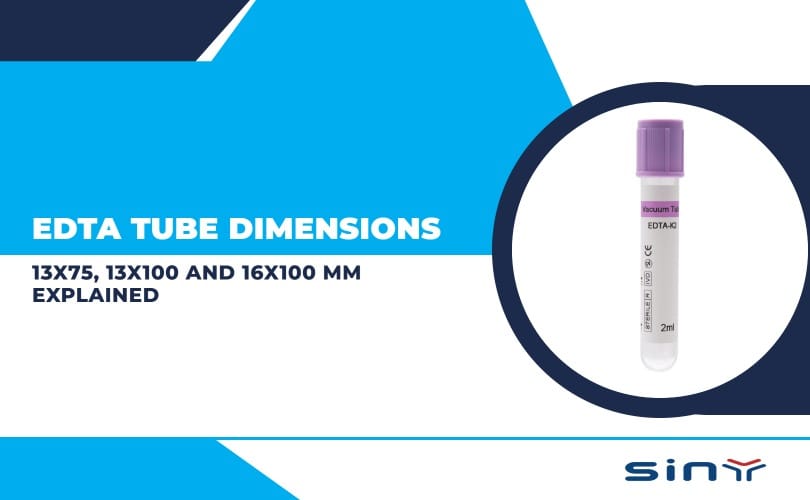
Most buyers order EDTA tubes by volume: 2 mL, 3 mL, 5 mL. Yet the lab often cares more about EDTA tube dimensions. If the diameter or length does not match the analyser rack, the tube will not load, and staff must transfer samples by hand. That costs time and adds risk.
This guide explains the common EDTA tube dimensions, how they relate to draw volume, and how to check fit before you place a bulk order. It is written for lab managers, hospital buyers and distributors. As an EDTA tube manufacturer, SINY gets this question often, so we have collected the practical answers here.
Why EDTA Tube Dimensions Matter as Much as Volume
A tube has to fit three things in the lab: racks, centrifuges and analysers. Many modern haematology analysers sample directly from closed tubes. Therefore, the tube must sit at the right height for the probe to reach the blood without hitting the bottom.
Track systems and decappers add more limits. Grippers hold tubes by their diameter, and sensors read the cap height. If a new tube is a few millimetres too long, the system may flag an error. As a result, a cheaper tube can end up costing more in staff time.
Dimensions also affect storage and shipping. Longer tubes need deeper trays and larger cartons. For importers, that means fewer tubes per pallet and higher freight per unit.
Common EDTA Tube Dimensions and Typical Volumes
Tube sizes are usually written as outer diameter by length, in millimetres. For example, 13×75 mm means a tube about 13 mm wide and 75 mm long. The same outer size can hold different draw volumes, because makers adjust vacuum and fill level.
The table below shows typical pairings seen across the market. Ranges vary by manufacturer, so always confirm with the product sheet.
| EDTA tube dimensions | Typical draw volumes | Common setting | Notes |
|---|---|---|---|
| 13×75 mm | About 2 to 4 mL | Routine haematology, outpatient clinics | Fits many standard racks and analysers |
| 13×100 mm | About 4 to 6 mL | Hospital labs, blood bank | Longer tube for larger volumes |
| 16×100 mm | About 8 to 10 mL | Blood bank, molecular testing | Wider tube; needs 16 mm racks |
| Micro / paediatric | Below 1 mL | Neonatal and paediatric care | Often non-vacuum; different holders |
SINY lists, for instance, 13×75 mm EDTA vacuum tubes in 2 mL and 3 mL, which suit many routine haematology setups.
How Draw Volume Relates to Tube Size
Draw volume is the amount of blood the tube collects. In a vacuum tube, the factory sets the vacuum so the tube fills to a nominal volume. The EDTA amount is matched to that volume.
That match is important. If a tube fills less than intended, the sample has relatively too much EDTA. This can change cell measurements, so labs train staff to fill tubes to the line. Consequently, buyers should never choose a larger tube and “partly fill it” to save blood.
For a full explanation of volumes, see our EDTA tube size guide from 2 mL to 10 mL. This article focuses on physical dimensions and fit.
Checking Analyser and Rack Compatibility
Before you switch to a new tube, check it against every device it will touch. Start with the analyser manual, which usually lists accepted tube diameters and lengths. Many manuals also give a maximum cap height.
Next, check racks and adaptors. Some racks accept only 13 mm tubes, while others use inserts for 16 mm. Then check the centrifuge buckets. A tube that fits the rack but not the bucket still causes problems.
Finally, run a live test. Load a batch of sample tubes onto each analyser and track system, and watch for errors. In practice, a one-day trial catches most fit problems before a full delivery arrives.
EDTA tube dimensions checklist for buyers
- Outer diameter and length, with tolerances
- Cap type, height and color
- Nominal draw volume and fill line position
- Accepted sizes in each analyser manual
- Rack, adaptor and centrifuge bucket sizes
- Label area and barcode position
Standards Behind Tube Dimensions
International standards set the framework for tube design and testing. ISO 6710 for single-use venous blood specimen containers sets requirements and test methods for evacuated and non-evacuated tubes.
In addition, many labs follow the Clinical and Laboratory Standards Institute document CLSI GP39 on tubes and additives for venous and capillary blood collection. These documents help labs compare products on a common basis, even when makers use different designs.
When you request quotes, ask suppliers which standards their test reports follow. A supplier that can share clear test data makes evaluation faster.
Material, Cap and Label Details That Affect Fit
Tube material changes weight and wall thickness. PET plastic tubes are light and resist breakage, so most labs now prefer them. Glass tubes are heavier and may have slightly different wall profiles. Even with the same nominal size, check the real dimensions.
Caps matter too. Some caps sit higher than others, which can affect analysers that sense cap height. Similarly, the cap color must match your lab chart, so staff and sorters recognise it at once.
Labels are often overlooked. If your hospital adds its own barcode label, the tube needs a free label area in the right place. A label placed too low or too high can block barcode readers on automated systems.
Choosing EDTA Tube Dimensions by Setting
Different settings tend to favour different sizes. Outpatient clinics often use 13×75 mm tubes with 2 to 4 mL volumes, because routine counts need little blood. Hospital labs may stock both 13×75 mm and 13×100 mm tubes.
Blood banks often use larger tubes, since crossmatch work can need more sample. Molecular labs sometimes prefer 16×100 mm tubes for higher volumes. Meanwhile, paediatric wards rely on micro tubes to protect small patients from excess blood loss.
Non-vacuum tubes deserve a mention here. They are filled by syringe or by drops, so the fill level depends on the user rather than the vacuum. SINY offers 2 mL non-vacuum EDTA K2 tubes for settings where gentle, low-volume collection matters. Even so, check their dimensions against your racks just as carefully as vacuum tubes.
Veterinary clinics also have specific needs. Small animals need small tubes, while large animal practices may use standard sizes. In each case, the right EDTA tube dimensions depend on the equipment and the patient, not just the price.
Stocking and Shipping Considerations
Each extra size adds a stock line, so buyers should keep the range lean. Review which dimensions your customers actually use and drop rare ones. However, keep at least one paediatric option if you serve hospitals.
Shipping costs depend on carton volume more than weight. Larger EDTA tube dimensions mean fewer tubes per carton and per pallet. Therefore, ask suppliers for carton sizes and pallet patterns for each size before you compare prices.
Shelf life also matters. Vacuum tubes keep their draw volume only within the labelled shelf life, so avoid overstocking slow sizes. Many EDTA tubes carry a shelf life of around two years under recommended storage, but always check the label.
Mistakes to Avoid When Changing EDTA Tube Dimensions
Switching tube size seems simple, but small changes ripple through the lab. The first mistake is changing size and supplier at the same time. If problems appear, nobody knows whether the cause is the new size or the new maker. Instead, change one thing at a time where possible.
The second mistake is forgetting the ward. Phlebotomists use holders, needles and transfer devices that must suit the new tube. For example, a 16 mm tube may need a different holder than a 13 mm tube. Therefore, include ward staff in the trial, not only lab staff.
The third mistake is ignoring barcode labels. When EDTA tube dimensions change, the label printer settings may need adjustment too. A label that wraps badly around a narrower tube can fail on scanners. In practice, print a test batch of labels before go-live.
Finally, update your training materials. Charts, photos and order sets should show the new tube. If staff still see the old size on posters, they may reach for the wrong stock. A short briefing at each collection point helps the change stick. You can also show staff real production footage on the SINY Medical YouTube channel to explain how the new tubes are made.
Cost and Buying Guide
Size, material and additive drive the unit price. Larger tubes use more material and space, so they usually cost a little more. Glass usually costs more to ship than PET because of weight and breakage.
Order volume and customisation also change the price. Custom labels, cap colors and packaging add set-up costs, but they help distributors build their own brand. In addition, combining sizes in one order can help you reach the supplier’s MOQ.
Questions to ask about EDTA tube dimensions
- What are the exact outer diameter and length, with tolerances?
- Which analysers have customers used these tubes on?
- Can you send samples of each size for a fit test?
- What is the MOQ per size and per volume?
- Which test reports and certificates cover these products?
Why Work with an EDTA Tube Manufacturer
A manufacturer can tell you the real measured dimensions, not just the catalogue size. It can also adjust labels, caps and packaging for your market. By contrast, a trading company may not have access to that data.
SINY manufactures EDTA tubes in sizes from 2 mL to 10 mL, in PET and glass. The factory covers 12,000 square metres with a capacity of up to 500,000 tubes per day. SINY offers OEM manufacturing and custom design, and lists CE and ISO 13485 certification for its EDTA tubes.
For larger volumes, SINY also offers 10 mL EDTA K2 vacuum tubes.
You can compare every size in the SINY EDTA tube range.
FAQ: EDTA Tube Dimensions
What are the standard EDTA tube dimensions?
The most common EDTA tube dimensions are 13×75 mm, 13×100 mm and 16×100 mm, measured as outer diameter by length. Smaller micro tubes serve paediatric patients. Each size is usually linked to a range of draw volumes, such as about 2 to 4 mL for 13×75 mm. Exact sizes vary by manufacturer, so always check the product sheet.
What size is a 3 mL EDTA tube?
A 3 mL EDTA vacuum tube is often made in a 13×75 mm format, although some makers use other sizes. The draw volume depends on the vacuum and fill level, not just the outer size. Before ordering, confirm the EDTA tube dimensions with your supplier and test them on your own analysers and racks.
Do all analysers accept the same tube size?
No. Each analyser and track system lists the tube diameters, lengths and cap heights it accepts. Many accept 13 mm tubes, while some need adaptors for 16 mm tubes. Check the manual and run a short trial with sample tubes. Matching EDTA tube dimensions to equipment prevents loading errors and manual sample transfers.
Is a 13×100 mm tube better than 13×75 mm?
Neither is better in general. A 13×100 mm tube holds more blood, so it suits tests that need larger samples, such as some blood bank work. A 13×75 mm tube suits routine counts and saves blood. Choose EDTA tube dimensions based on the tests, the patients and the equipment in each department.
Can I order mixed EDTA tube sizes in one shipment?
Yes, most manufacturers allow mixed sizes in one order, although each size may have its own MOQ. Combining sizes helps importers reach volume targets without overstocking one line. When you plan an order, ask the supplier for carton sizes per tube format, because different EDTA tube dimensions change how many cartons fit on a pallet.
Summary
EDTA tube dimensions decide whether a tube fits your racks, centrifuges and analysers. The common formats are 13×75 mm, 13×100 mm and 16×100 mm, each linked to typical draw volumes. Always confirm real dimensions, cap height and label position before switching suppliers.
Run a fit test with samples, keep your size range lean, and compare shipping costs per size. To get samples and product sheets for each size, contact the SINY team.