“The tubes are bad” is a common complaint, but it gives a manufacturer almost nothing to work with. Which tubes? Which lot? What happened, how often, and to whom? Clear records turn a vague concern into a problem that can be found and fixed. Good documentation of EDTA tube product complaints protects patients, speeds up answers and helps labs hold suppliers to account.
This guide explains what to record, what evidence to keep, how to send a complaint and what to expect back. It is written for lab quality managers, phlebotomy leads and distributor service teams. As an EDTA tube manufacturer, SINY receives and investigates complaints, so we know which details make the biggest difference.
Short answer: Document each EDTA tube complaint with the product name, tube size and additive, lot number and expiry, date and site, a clear description of the problem, how many tubes were affected out of how many used, photos, any patient impact, and retained sample tubes. Send it to the supplier in writing, keep a copy, and track the response against agreed timelines.
Key Takeaways
- The lot number is the single most important detail in any tube complaint.
- Record how many tubes failed and how many were used, not just that a failure happened.
- Keep unused tubes from the same lot and, if safe, the affected tubes.
- Note any patient impact, such as recollections or delayed results.
- Under medical device rules, serious incidents may need reporting to regulators.
Why Good Complaint Records Matter
Blood collection tubes are medical devices. Manufacturers must investigate complaints under their quality system, usually ISO 13485, and regulators may require reports for serious incidents. Investigators need facts to test: the lot, the conditions and real samples. Without them, the answer is often “no fault found”, even when there was a real problem.
What to Record in an EDTA Tube Complaint
| Field | Example |
|---|---|
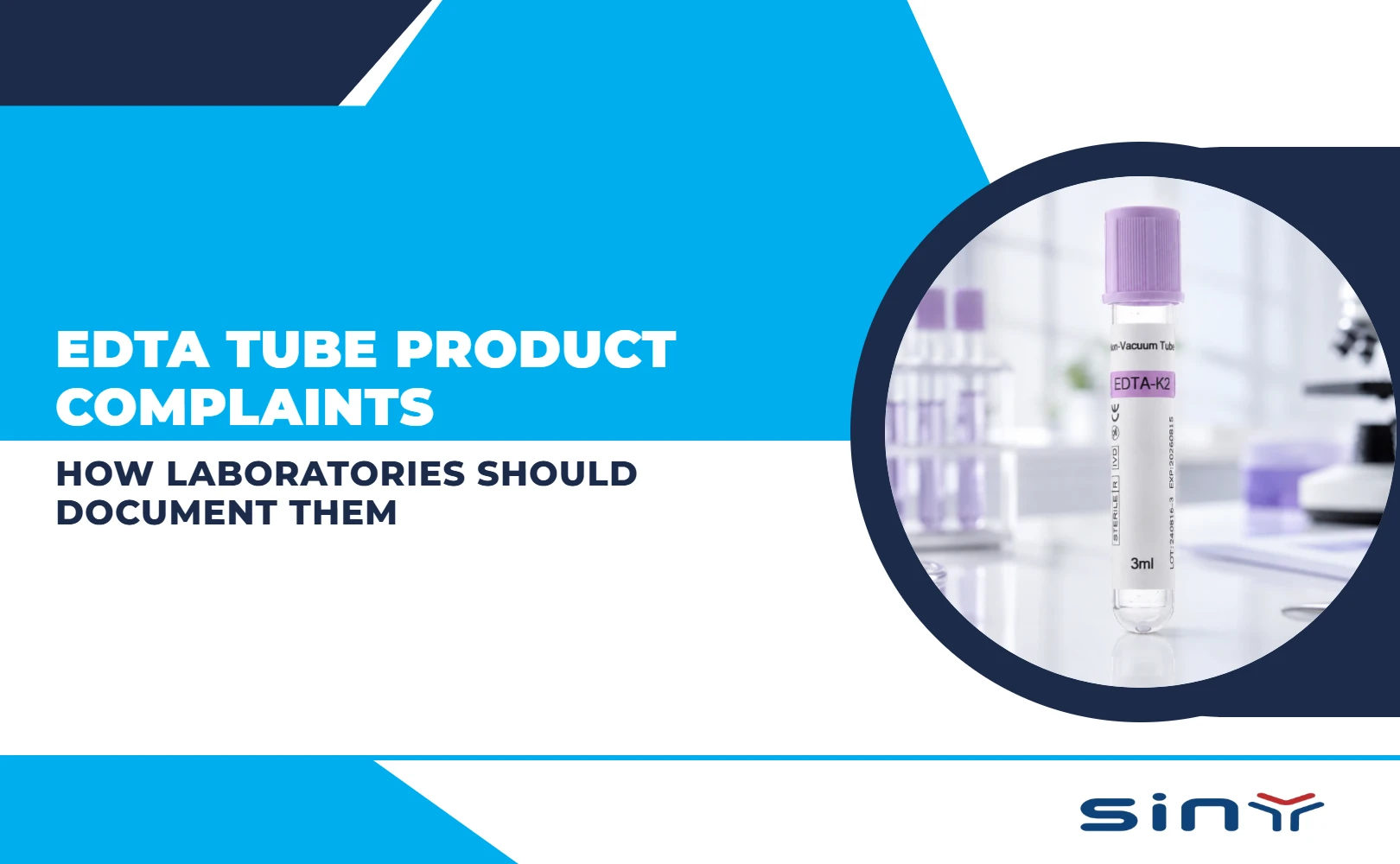
| Product | K2EDTA vacuum tube, 3 mL, 13×75 mm, lavender cap |
| Catalogue or model number | As printed on the box |
| Lot number and expiry | From tube label and box |
| Date and site | When and where the problem happened |
| Problem type | Short draw, leak, clot, cracked tube, label, cap |
| Description | What staff saw, step by step |
| Frequency | For example, 12 of 200 tubes used this week |
| Collection details | Needle size, holder, butterfly or syringe, staff experience |
| Storage conditions | Room temperature, stockroom location, any heat exposure |
| Patient impact | Recollection needed, results delayed, any injury or exposure |
| Evidence | Photos, retained tubes, analyser logs |
| Contact | Name and role of the person reporting |
Evidence to Keep
Photos
Take clear photos of the tube, label (showing lot and expiry), and the defect. For short draws, photograph the fill level against the fill line. For leaks, show where blood escaped.
Retained tubes
Keep unused tubes from the same lot, ideally from the same box. If safe and allowed by local rules, keep affected tubes, but never send biological material without following transport rules for infectious substances.
Data
Analyser error logs, rejection records and draw volume test results add strength. A simple water draw test on 10 tubes from the lot shows whether vacuum is the issue. See underfilled EDTA tubes.
Common Complaint Types and Extra Details
- Short draws: needle size, fill volume measured, storage temperature.
- Clots: time to inversion, number of inversions, transport time.
- Leaks or cracks: when found (on opening, after centrifuge, in transport), transport method. See pneumatic tube EDTA samples.
- Analyser errors: analyser model, error code, rack type.
- Label problems: printer type, storage conditions, cleaning agents.
Before Sending: Quick Checks
Rule out common non-tube causes so the complaint is focused:
- Were the tubes within expiry and stored correctly?
- Has anything else changed, such as new staff or new devices?
- Is the problem linked to one lot or many?
Our guide to EDTA tube lot-to-lot variation explains how to compare lots.
How to Send a Complaint
- Send it in writing to the supplier or distributor, using their complaint form if they have one.
- Attach photos and data, and offer retained tubes.
- Ask for a reference number and expected timeline.
- Decide whether to quarantine remaining stock from the lot.
- Check whether a serious incident must be reported to your regulator.
What to Expect from the Manufacturer
- Acknowledgement and a reference number.
- Review of production records and lot release results.
- Testing of retained samples and the tubes you return.
- A written report with root cause and corrective action.
- Agreement on replacement or credit if the lot is at fault.
Response times should be set in your quality agreement. See EDTA tube quality agreement.
Tracking Complaints Over Time
Keep a simple log with date, product, lot, problem type, supplier response and closure date. Review it every quarter. Trends show which problems repeat, which sites need training and whether a supplier is improving. This data also supports supplier reviews and tender decisions.
Complaint Support from SINY
SINY investigates complaints using lot records and retained samples. Send us the lot number, photos and a description, and our quality team will follow up. Browse the EDTA tube range.
FAQ: EDTA Tube Product Complaints
What information is needed for an EDTA tube complaint?
Product, size and additive, lot number and expiry, date and site, a clear description, how many tubes failed out of how many used, collection and storage details, patient impact, photos and retained tubes.
Why is the lot number important in a tube complaint?
It lets the manufacturer find production records, lot test results and retained samples for that exact batch. Without it, investigation is very limited.
Should I send used blood tubes to the manufacturer?
Only if they ask and only if you follow local rules for shipping biological material. Unused tubes from the same lot are usually more useful and safer to send.
How long does a tube complaint investigation take?
It depends on the issue and your agreement. Many manufacturers acknowledge within a few days and send a report within about a month, faster for safety issues.
Do tube complaints need to be reported to regulators?
Serious incidents involving medical devices may need reporting under local rules. Check your national requirements and inform the manufacturer.
Summary
Good documentation turns EDTA tube product complaints into problems that can be solved. Record the lot, the facts, the frequency and the impact, keep photos and retained tubes, and track the response. Over time, a complaint log shows clear trends.
To report a concern or ask about SINY lot records, contact our team.