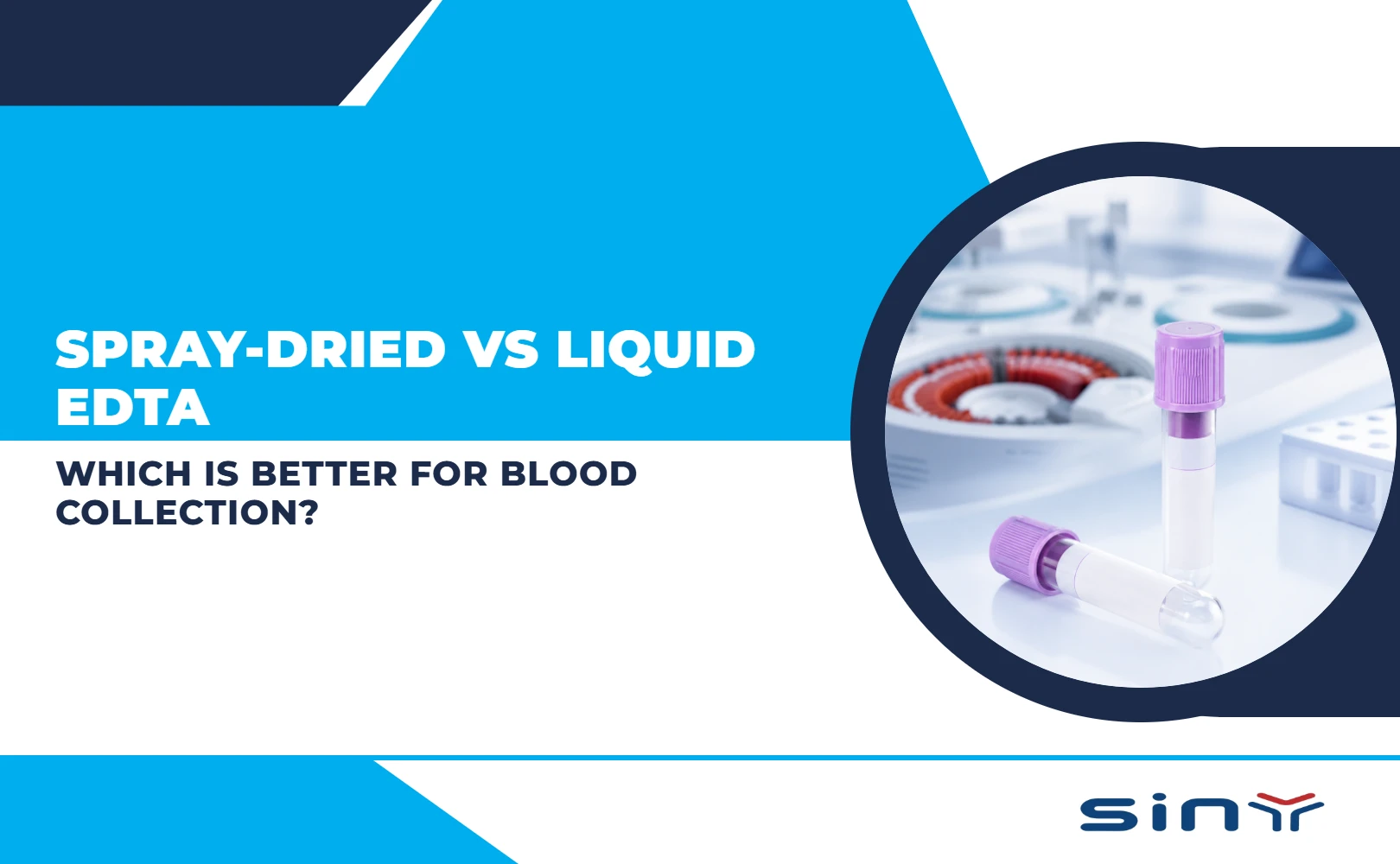
When labs compare spray-dried EDTA vs liquid EDTA, they are really asking one thing: which form gives the most accurate blood count with the least fuss? Both forms stop blood from clotting. However, they behave differently inside the tube, and that difference shows up in dilution, mixing time and the type of tube each one suits.
This guide explains how each form works, where each one fits, and what buyers should check before they order. It is written for lab managers, hospital buyers and distributors. As an EDTA tube manufacturer, SINY makes both K2 and K3 EDTA tubes, so we see these questions in almost every new inquiry.
Short answer: Spray-dried EDTA (usually K2EDTA) is the better choice for most routine haematology. It coats the tube wall as a dry film, so it does not dilute the sample and is the form recommended by the International Council for Standardization in Haematology (ICSH). Liquid EDTA (usually K3EDTA) mixes fast but dilutes blood by roughly 1 to 2 percent.
Key Takeaways
- Spray-dried EDTA is a thin dry layer on the tube wall; liquid EDTA is a small volume of solution at the bottom of the tube.
- Liquid EDTA adds volume, so it slightly lowers counts such as haemoglobin, red cells and platelets.
- ICSH recommends K2EDTA for blood cell counting and sizing, which is normally supplied spray-dried.
- Liquid K3EDTA is still used in some glass tubes and in markets with long-standing local methods.
- Whichever form you choose, correct fill volume and 8 to 10 gentle inversions matter more than the additive form alone.
What Is Spray-Dried EDTA?
Spray-dried EDTA is EDTA salt that is sprayed onto the inner wall of the tube as a fine mist and then dried. The result is a thin, almost invisible film. When blood enters the tube, it dissolves the film and the EDTA binds calcium, which stops the clotting cascade.
Most spray-dried tubes use dipotassium EDTA (K2EDTA). It dissolves well and spreads over a large surface, so it mixes quickly once the tube is inverted. Because nothing liquid is added, the blood volume in the tube stays exactly what was drawn.
Spray-dried EDTA is the standard choice for PET plastic tubes. Today most vacuum blood collection tubes sold worldwide are plastic, so spray-dried K2EDTA is now the most common format in routine labs. You can see typical formats in our K2 EDTA blood collection tubes.
What Is Liquid EDTA?
Liquid EDTA is a small volume of EDTA solution placed in the tube during production. It is usually tripotassium EDTA (K3EDTA), because K3 dissolves easily in water. The liquid sits at the bottom of the tube until blood is drawn.
Liquid EDTA was the traditional format for glass tubes. It mixes with blood very fast, which is one reason some labs still like it. However, the added liquid becomes part of the sample. That small extra volume dilutes the blood.
Spray-Dried EDTA vs Liquid EDTA: Side-by-Side Comparison
| Factor | Spray-dried EDTA | Liquid EDTA |
|---|---|---|
| Usual salt | K2EDTA | K3EDTA |
| Physical form | Dry film on the tube wall | Solution at the tube bottom |
| Sample dilution | None | About 1 to 2 percent |
| Typical tube material | PET plastic (also glass) | Glass (sometimes plastic) |
| Mixing | Needs proper inversion to dissolve the film | Mixes very quickly |
| Effect on cell size on storage | Smaller change in MCV | K3 can shrink red cells more over time |
| ICSH position | Recommended for cell counting | Acceptable but not preferred |
| Common use | Routine CBC, HbA1c, blood bank | Legacy methods, some regional markets |
How Each Form Affects Blood Test Results
Dilution and CBC values
Liquid EDTA adds a small volume to the sample. As a result, values that depend on concentration read slightly lower. Haemoglobin, red cell count, white cell count and platelet count can all drop by about 1 to 2 percent compared with a dry-additive tube. For one patient this may look minor. For a lab that compares results over time, or against reference ranges set with K2EDTA, it adds a small, steady bias.
Red cell size (MCV) and haematocrit
K3EDTA tends to shrink red cells a little more than K2EDTA, especially if the sample waits several hours before testing. Shrinking lowers the MCV and the haematocrit. This is one reason ICSH recommends K2EDTA for blood cell counting and sizing. For more detail on cell changes, read how EDTA affects platelets, white cells and red cells.
Platelets and white cells
Both forms preserve platelets and white cells well when the tube is filled and mixed correctly. Problems such as EDTA-induced platelet clumping are linked to the patient, not to the additive form. In those cases the lab uses a citrate tube as a backup, whatever EDTA form is in stock.
Why Most Labs Now Choose Spray-Dried K2EDTA
- No dilution: the result reflects the patient’s blood, not blood plus additive.
- Standard alignment: ICSH guidance and most analyser makers use K2EDTA as the reference.
- Plastic tubes: spray-dried coating works well on PET, which is lighter and safer than glass.
- Stable storage: a dry additive cannot leak or evaporate before use.
- Cleaner shipping: no liquid means less risk if a tube cracks in transit.
For these reasons, spray-dried K2EDTA has become the default for routine CBC testing. Still, there are cases where liquid K3EDTA makes sense.
When Liquid EDTA Still Makes Sense
- The lab uses glass tubes and has validated its reference ranges on K3EDTA.
- A national tender or local guideline names K3EDTA specifically.
- Staff work in settings where fast mixing is hard to guarantee and the lab accepts the small dilution.
If you switch from liquid K3 to spray-dried K2, run a short comparison first. Test paired samples on your analyser and check the bias for haemoglobin, MCV and platelets. Our guide to K2 EDTA vs K3 EDTA tubes covers the salt differences in more depth.
EDTA Concentration: Same Target for Both Forms
Whatever the form, the tube is designed to deliver a set amount of EDTA per millilitre of blood. ICSH guidance gives a range of about 1.5 to 2.2 mg of EDTA per mL of blood, and ISO 6710 sets requirements for additive amounts in single-use venous blood collection containers. The amount only works if the tube fills to its stated draw volume. An underfilled tube gives too much EDTA for the blood present, which can shrink cells and distort results.
Handling Tips for Both Forms
- Fill the tube until the vacuum stops drawing blood. Do not remove it early.
- Invert gently 8 to 10 times right after collection. Do not shake. See our guide on EDTA tube inversion.
- Check for clots before analysis, especially with spray-dried tubes that were not mixed.
- Store unused tubes at room temperature, away from heat and direct sun.
- Use tubes before expiry, because vacuum slowly falls over time.
What Buyers Should Check Before Ordering
- Which salt and form the tube uses (K2 spray-dried or K3 liquid).
- Stated EDTA amount per mL of blood, and how the maker controls it batch to batch.
- Tube material (PET or glass) and size, such as 13×75 mm or 13×100 mm.
- Draw volume accuracy and shelf life on the label.
- Test reports against ISO 6710 and the quality certificate (for example ISO 13485).
- Compatibility with your analysers and racks, checked with samples.
Our EDTA tube supplier checklist gives a full list of points to confirm before you buy.
How SINY Supports Both Options
SINY supplies spray-dried K2EDTA tubes for routine haematology and K3EDTA tubes for buyers whose methods or tenders require them. We can share product sheets, test data and samples so your lab can compare forms on its own equipment. Browse the EDTA tube range or watch product videos on the SINY Medical YouTube channel.
FAQ: Spray-Dried EDTA vs Liquid EDTA
Is spray-dried EDTA better than liquid EDTA?
For most routine blood counts, yes. Spray-dried EDTA does not dilute the sample, and it is normally K2EDTA, which ICSH recommends for blood cell counting. Liquid EDTA works, but it dilutes blood by about 1 to 2 percent and can shrink red cells more on storage.
Does liquid EDTA affect CBC results?
Slightly. The added liquid lowers concentration-based values, such as haemoglobin, red cells and platelets, by around 1 to 2 percent. K3EDTA can also lower MCV over time. The effect is small but steady, so labs should not mix tube types without checking results.
Why is K2EDTA usually spray-dried?
K2EDTA dries into a fine, even film that coats plastic tube walls well and dissolves quickly when blood enters. K3EDTA is more soluble in water, so it is easier to supply as a liquid. That is why K2 is usually spray-dried and K3 is usually liquid.
Do spray-dried EDTA tubes need more mixing?
They need proper mixing, not harder mixing. Invert the tube gently 8 to 10 times right after collection so blood dissolves the dry film evenly. Skipping inversion is a common cause of small clots in spray-dried tubes.
Can I switch from liquid K3 to spray-dried K2 tubes?
Yes, many labs have done so. Run a short comparison first with paired samples on your own analyser, check any bias in key values, and update reference ranges if needed. Ask your supplier for samples to support the study.
Summary
In the spray-dried EDTA vs liquid EDTA question, spray-dried K2EDTA wins for most routine labs. It does not dilute the sample, it matches ICSH guidance, and it suits modern PET tubes. Liquid K3EDTA still has a place where methods, tenders or glass tubes call for it.
Whichever form you use, correct filling and gentle inversion protect the result. To compare both forms on your own analysers, contact the SINY team for samples and product sheets.