In a busy laboratory, specimen volume matters more than many people realize. A tube must contain enough blood for the requested tests, possible repeats, and additional procedures. At the same time, collecting more blood than necessary provides little benefit.
6 mL EDTA Tubes sit toward the larger end of routine EDTA collection options. They provide a generous whole-blood specimen for hematology workflows that may require more than a single analyzer run.
EDTA prevents coagulation by binding calcium ions that participate in the clotting cascade. FDA documentation for K2EDTA blood collection tubes describes this same mechanism: the tube wall contains K2EDTA, which binds calcium and blocks coagulation.
Because EDTA helps maintain anticoagulated whole blood for cellular testing, it has a long-established role in hematology. A scientific review describes EDTA as the preferred anticoagulant for many hematological procedures because it supports preservation of cellular components.
A 6 mL tube is not automatically better than a 2 mL, 3 mL, 4 mL, or 5 mL alternative. Instead, laboratories should select a volume that matches the analyzer, testing plan, patient population, and likelihood of repeat work.
Buyers can compare available formats through the EDTA Tube product range and the dedicated EDTA blood collection tube category.
What Are 6 mL EDTA Tubes?
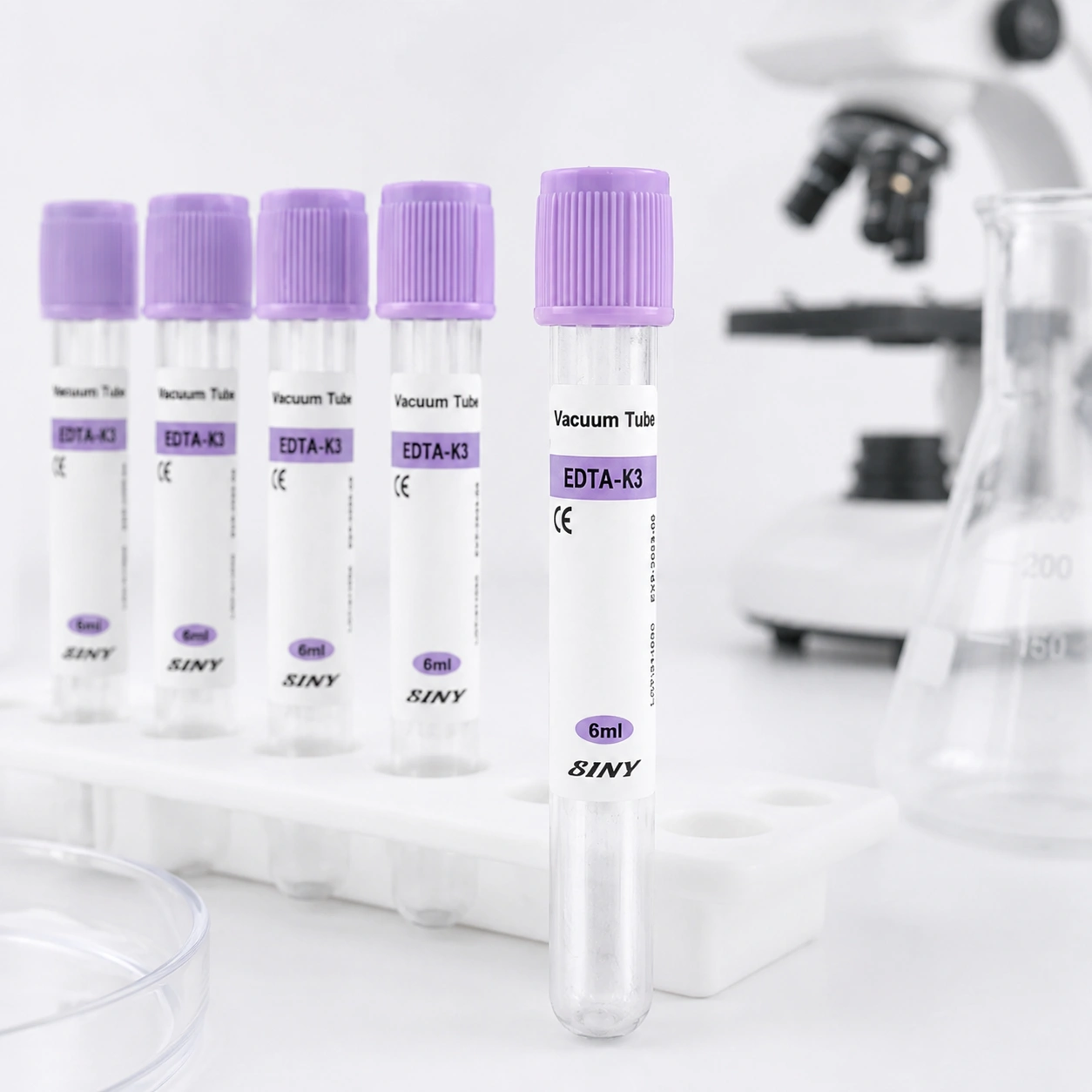
6 mL EDTA Tubes are blood collection tubes designed to collect approximately six milliliters of blood with EDTA as the anticoagulant.
Depending on the product, the additive may be K2EDTA or K3EDTA. Both types prevent clot formation through calcium chelation, although their formulation and laboratory effects are not identical.
The EDTA Tube supplier’s sizing table lists a 6 mL configuration measuring 13 × 100 mm. It lists both EDTA K2 and EDTA K3 options, PET or glass construction, and a purple closure.
For comparison, the same sizing table lists 2 mL through 5 mL tubes at 13 × 75 mm. The 6 mL and 7 mL versions move to a longer 13 × 100 mm format.
That physical difference matters for purchasing. Laboratories should confirm that racks, transport systems, sample handlers, and other equipment can accommodate the selected tube dimensions.
The 1–10 mL K2 EDTA vacuum blood collection range provides more information about the available volume range.
Why 6 mL EDTA Tubes Can Make Sense
The main benefit of 6 mL EDTA Tubes is additional working specimen.
A routine hematology analyzer may use only part of the collected blood during the first measurement. However, laboratory requirements often extend beyond that first aspiration.
An instrument may generate a flag. The technologist may need to repeat the CBC. A peripheral blood smear may be required. Another compatible procedure may also be requested.
In these situations, having more specimen can reduce the chance that the original tube becomes exhausted before the laboratory finishes its work.
However, larger volume does not automatically improve analytical accuracy.
The most important factors remain correct additive, suitable blood-to-additive ratio, proper collection, mixing, storage, and validated analyzer requirements. Therefore, 6 mL EDTA Tubes are most useful when the additional volume serves a real workflow need.
Common Applications of 6 mL EDTA Tubes
Complete Blood Count Testing
One of the primary applications for 6 mL EDTA Tubes is complete blood count testing.
A CBC examines major cellular components of blood. Depending on the analyzer and reporting profile, measurements can include red blood cell count, white blood cell count, platelet count, hemoglobin, hematocrit, and several calculated indices.
EDTA collection systems are intended primarily for hematology testing because the anticoagulant provides whole blood while preventing clot formation. FDA documentation for EDTA collection tubes identifies hematology as a core application.
The EDTA Tube product information also identifies CBC testing among the common applications of K2EDTA vacuum blood collection tubes.
A 6 mL specimen may provide more blood than a basic CBC requires. Its value becomes clearer when repeat analysis or other compatible procedures are expected.
White Blood Cell Differential
A CBC with differential evaluates both the total white blood cell count and major leukocyte populations.
Modern hematology analyzers commonly report neutrophils, lymphocytes, monocytes, eosinophils, and basophils as part of this workflow.
6 mL EDTA Tubes can provide enough specimen for the initial analysis while leaving reserve material if an instrument flag requires further review.
If abnormal cells are suspected, the laboratory may need a microscopic examination or additional validated testing. In such circumstances, a larger specimen can offer practical flexibility.
Red Blood Cell Measurements
EDTA whole blood also supports standard red blood cell measurements.
These commonly include RBC count, hemoglobin, hematocrit, mean corpuscular volume, and other red-cell indices.
The suitability of EDTA for cell counting and sizing has been recognized in hematology standardization. Scientific literature also identifies EDTA as an established anticoagulant for preserving cellular components during hematological testing.
Therefore, 6 mL EDTA Tubes may fit laboratories that perform routine CBC work alongside additional red-cell investigations.
Platelet Counts
Platelet measurement is another common EDTA-based hematology procedure.
However, laboratories should recognize one important limitation. Some patients demonstrate EDTA-dependent pseudothrombocytopenia. In these specimens, platelets clump in vitro after exposure to EDTA.
An analyzer can then report a platelet value that is falsely low. The phenomenon is a recognized laboratory artifact and may require confirmation using the laboratory’s established investigation procedure.
The problem does not make 6 mL EDTA Tubes unsuitable for routine platelet testing. Instead, it highlights the importance of reviewing unexpected results and analyzer flags.
6 mL EDTA Tubes for Peripheral Blood Smears
Automated hematology analyzers process most routine blood counts quickly. Yet microscopic blood-film examination still matters when the automated result raises questions.
A smear may help investigate unusual white-cell findings, red-cell morphology, platelet clumping, immature cells, or analyzer flags.
With 6 mL EDTA Tubes, the laboratory may have sufficient reserve specimen after the automated analysis to prepare additional blood films.
Still, volume alone does not protect morphology.
The laboratory should prepare and examine specimens within its validated time limits because cellular changes can occur during storage. Test-specific analyzer instructions and local procedures should determine acceptable specimen stability.
6 mL EDTA Tubes for Blood Grouping and Immunohematology
EDTA-anticoagulated specimens can also appear in selected immunohematology workflows.
FDA information for certain EDTA blood collection systems includes routine immunohematology applications such as ABO grouping, Rh typing, antibody screening, red-cell phenotyping, and direct antiglobulin testing. The same documentation stresses that users need to validate the specific assay, instrument, reagent system, and storage conditions.
Therefore, 6 mL EDTA Tubes may be useful in some blood-bank workflows when the receiving laboratory accepts that exact collection system.
This distinction matters.
A tube that works well for a CBC should never be assumed suitable for every transfusion-related test. Local blood-bank procedures take priority.
Can 6 mL EDTA Tubes Be Used for Molecular Testing?
Some molecular workflows accept EDTA whole blood.
The EDTA Tube product page lists molecular diagnostics and genetic-testing preparation among the possible applications of its K2EDTA collection tubes.
However, 6 mL EDTA Tubes should only be used when the specific molecular assay accepts that specimen type.
Different tests can specify different anticoagulants, minimum volumes, storage conditions, transport temperatures, or processing requirements.
For that reason, laboratories should verify the assay’s official instructions before collecting a 6 mL specimen for PCR, DNA analysis, or another molecular procedure.
6 mL EDTA Tubes vs Smaller EDTA Tube Sizes
The easiest way to choose a tube is to compare the collection volume with the expected laboratory workload.
| Tube Size | Typical Practical Fit | Main Benefit | Main Consideration |
|---|---|---|---|
| 2 mL | Low-volume or selected pediatric workflows | Minimizes collected blood | Limited reserve specimen |
| 3 mL | Routine basic hematology | Balanced smaller collection | Less material for extensive repeats |
| 4 mL | Routine adult CBC workflows | Good general-purpose volume | May not support multiple additional procedures |
| 5 mL | Broader routine hematology | More reserve specimen | May exceed a simple CBC requirement |
| 6 mL | Higher-volume hematology or multi-step workflows | More specimen for repeats and compatible add-ons | Unnecessary for many basic tests |
The supplier’s product tables list 2 mL through 10 mL EDTA configurations. They show 6 mL tubes at 13 × 100 mm compared with 13 × 75 mm for the 2–5 mL sizes.
Laboratories comparing smaller formats can also review the guides to 2 mL EDTA Tubes, 3 mL EDTA Tubes, 4 mL EDTA Tubes, and 5 mL EDTA Tubes.
The best choice is not the biggest tube. It is the smallest validated size that supports the complete testing workflow.
Why Correct Fill Volume Matters
A common misconception is that a 6 mL tube can simply be filled with three or four milliliters when less blood is available.
That approach can create problems.
The additive inside 6 mL EDTA Tubes is designed for an intended amount of blood. Significant underfilling increases the relative concentration of EDTA within the specimen.
Research into underfilled K2EDTA blood collection tubes found acceptable results for many automated CBC parameters under specific experimental conditions. However, platelet counts showed increasing negative bias as the specimen volume fell.
The study does not provide universal permission to underfill EDTA tubes.
Its findings depended on the tube, analyzer, parameters, and study design. Therefore, laboratories should follow the manufacturer’s intended fill and establish validated minimum-volume criteria for their own testing systems.
Correct filling becomes particularly important with 6 mL EDTA Tubes because collecting only a small fraction of the intended volume can substantially alter the blood-to-additive relationship.
K2EDTA vs K3EDTA in 6 mL Tubes
One of the most important purchasing decisions involves the EDTA formulation.
K2EDTA means dipotassium EDTA. K3EDTA means tripotassium EDTA.
Both forms bind calcium and prevent coagulation. However, buyers should not treat them as identical products.
FDA documentation describes K2EDTA tubes with K2EDTA coating on the tube wall and confirms that the additive binds calcium ions to block the coagulation cascade.
The EDTA Tube product information lists both K2 and K3 formulations across several blood collection volumes, including the 6 mL format.
Laboratories should select the formulation specified by their analyzer manufacturer and validated operating procedure.
For broader comparison, see the K2 EDTA blood collection tube range and the guide comparing K2 EDTA vs heparin tubes.
How EDTA Prevents Blood Clotting
The chemistry behind 6 mL EDTA Tubes is relatively simple.
Calcium participates in several stages of the coagulation process. EDTA acts as a chelating agent, meaning it binds metal ions such as calcium.
When calcium becomes bound to EDTA, it is no longer freely available to support normal clot formation.
FDA device documentation confirms this mechanism for K2EDTA collection systems.
For readers interested in the chemistry itself, the overview of ethylenediaminetetraacetic acid explains EDTA’s metal-binding properties.
The EDTA Tube guide explaining purple tube identification provides additional background about how these tubes are recognized in laboratory collection systems.
Why EDTA Is Not Suitable for Every Test
The presence of a large blood volume does not make an EDTA specimen universally useful.
6 mL EDTA Tubes are primarily associated with hematology and selected validated whole-blood procedures.
Routine coagulation testing typically uses citrate-based collection rather than EDTA because the testing process depends on a controlled anticoagulant system.
Likewise, many chemistry procedures require serum or heparinized plasma rather than EDTA whole blood.
CLSI maintains specific standards covering blood collection devices, additives, and venous specimen collection, reinforcing the importance of choosing the collection system for its intended laboratory purpose.
Tube selection should always begin with the test requirement rather than convenience.
Proper Collection and Mixing of 6 mL EDTA Tubes
Correct collection protects specimen quality before testing even begins.
Staff should verify patient identification, requested tests, tube type, EDTA formulation, expiration date, and target draw volume.
After collection, 6 mL EDTA Tubes need proper mixing so the blood contacts the anticoagulant evenly.
The SINY/EDTA Tube K2 vacuum product instructions specify gentle inversion after collection and advise against vigorous shaking.
Laboratories should follow the exact instructions supplied with the purchased product rather than assuming that every manufacturer specifies the same number of inversions.
Poor mixing can leave parts of the specimen inadequately anticoagulated. Meanwhile, aggressive handling can negatively affect specimen quality.
Where EDTA Fits in the Order of Draw
When multiple tubes are collected during one venipuncture, sequence matters.
CLSI lists EDTA after heparin tubes and before sodium fluoride/potassium oxalate tubes in the standard order of draw.
The sequence described by CLSI is blood culture first, followed by citrate, serum, heparin, EDTA, and finally glycolytic-inhibitor tubes.
Therefore, 6 mL EDTA Tubes should occupy the standard EDTA position during multi-tube collection.
Following the correct sequence helps reduce additive carryover between collection tubes.
Major Benefits of 6 mL EDTA Tubes
The first advantage is specimen reserve.
A 6 mL collection can leave more whole blood available after the first analyzer run. This can be useful for repeat measurements, smear preparation, or other compatible procedures.
Another benefit is workflow flexibility.
When the laboratory cannot predict whether an abnormal CBC will need further investigation, 6 mL EDTA Tubes provide more material than smaller formats.
The larger volume can also make sense in workflows where one validated specimen supports several compatible procedures.
However, these benefits only matter if the laboratory actually needs the extra blood.
A simple outpatient CBC may be fully supported by a smaller tube. In that situation, selecting 6 mL provides little operational advantage.
When a 6 mL EDTA Tube May Be Too Large
More blood is not always better.
For pediatric patients, people with difficult venous access, or patients who undergo frequent blood collection, unnecessary draw volume should be avoided whenever a smaller validated tube meets the testing requirement.
A 2 mL or 3 mL format may make more sense for a basic low-volume workflow. The 3 mL EDTA tube guide discusses this smaller-volume approach.
Similarly, a routine adult CBC may not require the reserve provided by 6 mL EDTA Tubes.
Before standardizing on a larger tube, laboratories should calculate how much specimen they actually use during routine testing and how frequently repeat or add-on work occurs.
Buyer Considerations for 6 mL EDTA Tubes
Purchasing decisions deserve more attention than simply comparing unit price.
Confirm Tube Dimensions
The supplier’s product table lists its 6 mL EDTA configuration at 13 × 100 mm. Buyers should confirm compatibility with racks, holders, transport carriers, and laboratory automation before ordering.
Verify K2 or K3 EDTA
Do not order a tube based only on the words “EDTA tube.”
Confirm whether the laboratory requires K2EDTA or K3EDTA. The selected product must match the analyzer, assay, and validated laboratory procedure.
Check Tube Material
The supplier lists PET and glass among its available materials.
Buyers should verify which construction is supplied for the exact product code they intend to purchase.
Evaluate Closure and Vacuum Performance
A vacuum tube must draw its intended specimen volume consistently.
The EDTA Tube product page describes a controlled vacuum system and lists safety-cap and rubber-stopper closure configurations.
Buyers should therefore request specifications for draw volume, closure design, and vacuum shelf-life performance.
Review Regulatory and Quality Documentation
The product page lists CE, ISO 13485, and ISO 9001 among its stated certifications.
However, buyers should request current certificates, product-specific documentation, and market-specific regulatory evidence before making procurement decisions. A website claim alone should not replace document verification.
Check Lot Traceability and Label Quality
The tube should allow clear identification of the additive, volume, manufacturer, lot information, and expiration details.
CLSI’s GP39 standard addresses materials, manufacturing, and labeling requirements for venous and capillary blood collection devices.
For high-volume laboratory procurement, consistent labeling and traceability can be just as important as unit cost.
Evaluating a Supplier
A reliable supplier should provide enough information for the buyer to evaluate the exact product being purchased.
The SINY Medical EDTA tube page provides manufacturer-oriented product information. The SINY Medical Made-in-China profile offers additional commercial information, while the SINY Medical YouTube channel contains company and product videos.
These resources can help with supplier research, but they should not serve as the sole basis for clinical or regulatory decisions.
A buyer should request current specifications, certificates, packaging information, manufacturing details, product samples when appropriate, and documentation relevant to the destination market.
The broader EDTA Tube product catalog can also help buyers compare sizes before settling on 6 mL EDTA Tubes.
Common Purchasing and Laboratory Mistakes
One mistake is buying a larger tube simply because it appears more versatile.
If the laboratory routinely needs only three or four milliliters, a 6 mL product may increase unnecessary blood collection.
Another mistake is confusing tube capacity with acceptable underfilling.
A 6 mL tube should not automatically become a 3 mL tube because the phlebotomist stops the draw early. Underfilling changes the relationship between blood and anticoagulant, and research shows that some hematology parameters can become affected under specific conditions.
A third mistake is relying only on the purple cap.
Closure colors aid identification, but laboratories should verify the additive and volume printed on the tube.
Finally, buyers should avoid selecting a product solely from website claims. Product-specific documentation and laboratory validation should confirm whether 6 mL EDTA Tubes fit the intended workflow.
Summary
6 mL EDTA Tubes can be a practical option for laboratories that need a larger EDTA-anticoagulated whole-blood specimen.
They offer more reserve than smaller formats, which can help when CBC testing leads to repeat analysis, smear preparation, or another compatible procedure.
However, the extra volume should serve a clear purpose.
Tube size does not replace correct anticoagulant selection, fill volume, mixing, order of draw, analyzer compatibility, storage control, or laboratory validation. FDA and CLSI documentation both reinforce the importance of using blood collection systems according to their intended design and validated laboratory procedures.
For procurement, laboratories should also examine tube dimensions, K2 versus K3 EDTA, material, closure system, vacuum performance, labeling, quality documentation, and market-specific regulatory requirements.
The most practical rule remains simple: choose the smallest validated EDTA tube that provides enough specimen for the complete expected workflow.
To compare options, visit the EDTA Tube homepage, explore the EDTA tube product category, review EDTA tubes for blood collection, or contact EDTA Tube for product-specific information.
Frequently Asked Questions
What are 6 mL EDTA Tubes commonly used for?
6 mL EDTA Tubes are mainly useful for hematology workflows that need anticoagulated whole blood, including CBC testing and other validated cellular procedures. Their larger volume can provide additional specimen for repeats, blood-film preparation, or compatible follow-up tests.
Are 6 mL EDTA Tubes better than 5 mL tubes?
Not automatically. 6 mL EDTA Tubes provide one additional milliliter of specimen, which may help laboratories that frequently need repeat or additional testing. A 5 mL or smaller tube may be more appropriate when the extra volume offers no practical benefit.
Can 6 mL EDTA Tubes contain K2EDTA or K3EDTA?
Yes. The supplier’s product sizing information lists 6 mL EDTA Tubes with either K2EDTA or K3EDTA options. Laboratories should confirm the exact additive required by their analyzer and validated procedures before purchasing.
Can 6 mL EDTA Tubes be underfilled?
Significant underfilling of 6 mL EDTA Tubes should not be assumed acceptable. Underfilling changes the blood-to-anticoagulant relationship, and research on K2EDTA specimens has shown parameter-dependent effects. Follow the manufacturer’s target draw and laboratory-validated minimum volume.
Are 6 mL EDTA Tubes suitable for molecular testing?
Some molecular assays accept EDTA whole blood, so 6 mL EDTA Tubes may be suitable when the specific method permits them. The laboratory should confirm additive type, minimum volume, specimen stability, transport conditions, and processing requirements before collection.
What should buyers check before ordering 6 mL EDTA Tubes?
Before purchasing 6 mL EDTA Tubes, buyers should check additive type, 13 × 100 mm tube compatibility where applicable, material, target draw volume, closure system, labeling, lot traceability, regulatory documentation, shelf life, and analyzer compatibility. The exact specifications should be verified for the chosen product.