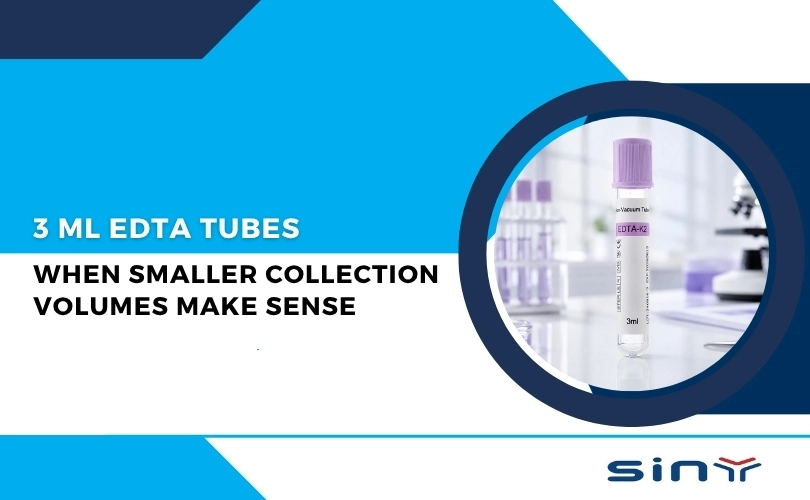
Blood collection is not simply about drawing enough blood. The laboratory also needs the right amount of blood in the right tube for the requested test. That is where 3 mL EDTA Tubes can make practical sense.
A 3 mL tube sits between very small pediatric collection tubes and larger routine laboratory tubes. It provides enough whole blood for many common hematology workflows without collecting more specimen than necessary. For clinics, diagnostic centers, outpatient laboratories, and selected hospital departments, that balance can improve both specimen management and patient comfort.
EDTA, or ethylenediaminetetraacetic acid, works by binding calcium ions that are required for normal coagulation. This prevents blood from clotting inside the tube. Because EDTA also supports preservation of cellular components, it has become a standard anticoagulant for hematology testing. A published review describes EDTA as the anticoagulant of choice for many hematological applications because of its ability to preserve blood-cell morphology.
For laboratories reviewing collection options, the EDTA Tube product catalog and dedicated EDTA blood collection tube range provide several tube sizes and configurations.
So, when should a laboratory choose 3 mL EDTA Tubes instead of 2 mL, 4 mL, or 5 mL options? The answer depends on the test menu, analyzer requirements, patient population, and the possibility of repeat testing.
What Are 3 mL EDTA Tubes?
3 mL EDTA Tubes are blood collection tubes designed for a nominal blood volume of approximately three milliliters. They contain an EDTA anticoagulant, commonly K2EDTA or K3EDTA, depending on the product design.
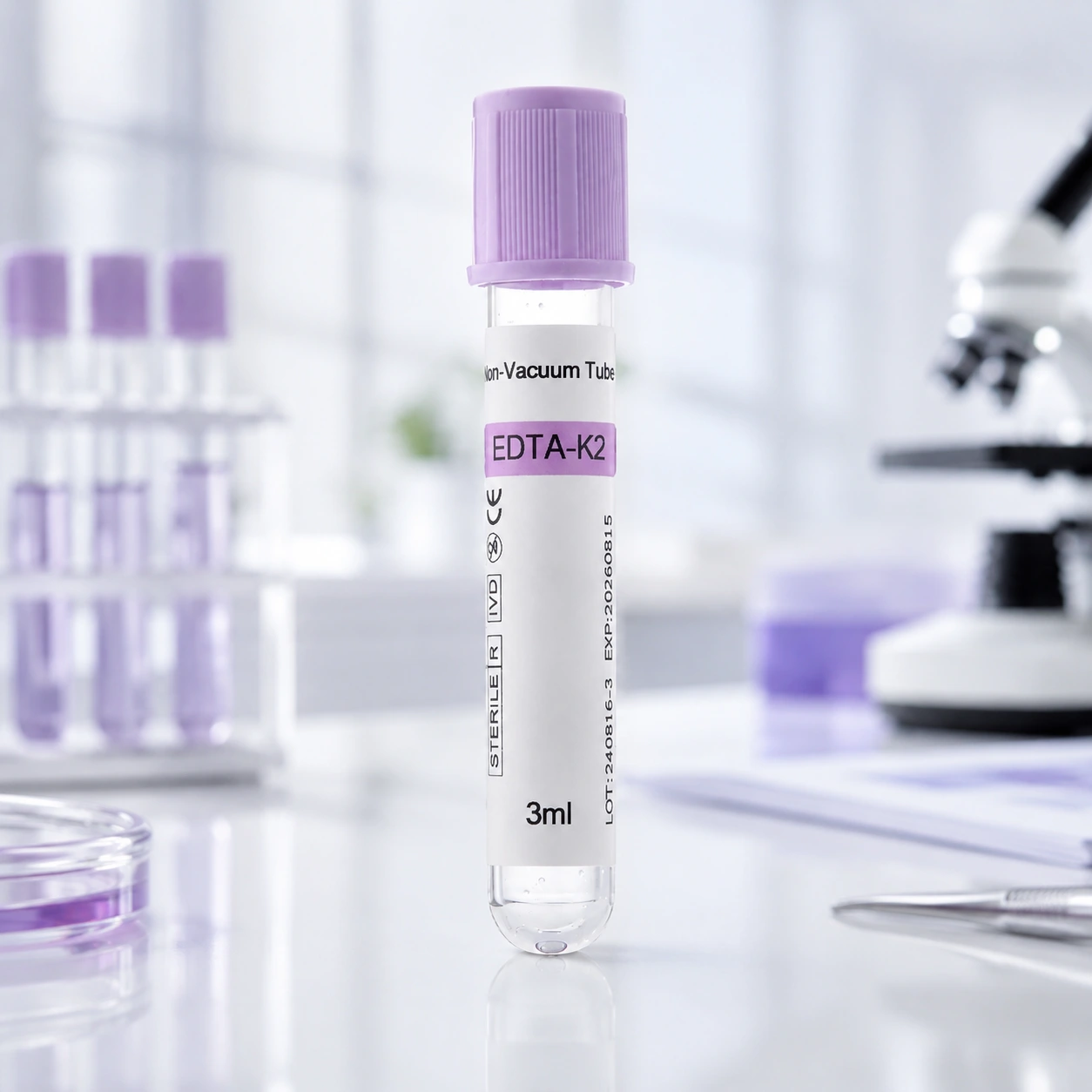
The EDTA binds calcium after blood enters the tube. Consequently, the coagulation cascade cannot proceed normally, and the specimen remains anticoagulated for suitable laboratory analysis.
International hematology recommendations have favored dipotassium EDTA, or K2EDTA, for blood-cell counting and sizing. The International Council for Standardization in Haematology recommended K2EDTA as the anticoagulant of choice for these purposes.
This is why many modern hematology laboratories use products such as K2 EDTA blood collection tubes.
The purple or lavender closure commonly associated with EDTA also helps laboratory staff identify the tube during collection. However, color alone should never replace reading the tube label. Manufacturers may use different closure shades or configurations.
Readers who want more background can explore why EDTA tubes are purple and how the purple-cap EDTA anticoagulant system works.
Why 3 mL EDTA Tubes Can Be a Practical Middle Ground
One reason 3 mL EDTA Tubes are useful is simple: they provide a moderate specimen volume.
A 2 mL tube may work well when only a small amount of blood is required. However, it leaves less reserve specimen if the analyzer produces a flag or the laboratory needs a repeat analysis.
A 4 mL or 5 mL tube provides more blood. Yet that additional volume may be unnecessary for a straightforward routine hematology request.
The EDTA Tube size guide describes the 3 mL format as suitable for routine hematology in clinics and smaller laboratories. It lists common uses such as CBC testing and selected analyzer-dependent procedures.
Therefore, 3 mL EDTA Tubes often occupy a useful middle position. They offer more working volume than a very small tube while avoiding unnecessary collection when larger volumes provide no analytical benefit.
Common Laboratory Uses of 3 mL EDTA Tubes
Complete Blood Count Testing
Complete blood count testing is one of the strongest applications for 3 mL EDTA Tubes.
A CBC typically evaluates red blood cells, white blood cells, hemoglobin, hematocrit, platelets, and several calculated indices. Modern hematology analyzers may also provide a white-cell differential and other parameters.
EDTA works particularly well in this setting because it keeps the sample anticoagulated while helping maintain cellular characteristics needed for automated counting. The scientific literature has long recognized EDTA’s suitability for hematological testing.
A 3 mL specimen can provide enough material for routine automated testing on many systems. However, laboratories should never assume that one volume works for every analyzer.
The required specimen depends on the analyzer’s aspiration volume, dead volume, sampling mode, repeat-test policy, and laboratory validation.
For that reason, 3 mL EDTA Tubes should be selected according to the complete workflow rather than tube capacity alone.
White Blood Cell Differential Testing
Many CBC analyzers perform an automated white blood cell differential from the same EDTA whole-blood specimen.
This makes 3 mL EDTA Tubes efficient for routine workflows because one collection may support both the CBC and differential when sufficient specimen remains.
Research examining K2EDTA tubes has also assessed CBC, white-cell differential, and reticulocyte measurements across different fill volumes. In one study, 1 mL and 2 mL specimens showed good agreement with a standard 4 mL collection for many tested parameters on the specific analyzer studied.
However, that finding should not become a general rule for accepting underfilled tubes.
Laboratories should follow their tube manufacturer’s fill requirements and validate any minimum specimen volume before changing acceptance criteria.
Hemoglobin and Hematocrit Analysis
Hemoglobin and hematocrit form part of most routine CBC profiles. Therefore, laboratories commonly measure them using blood collected into 3 mL EDTA Tubes.
The advantage here is not that 3 mL produces a better hemoglobin result than every other EDTA tube size. Instead, the volume can provide a practical specimen reserve without requiring a large blood draw.
Sample quality still matters more than nominal tube capacity.
Clotted blood, incorrect anticoagulant exposure, poor mixing, unsuitable storage, or excessive delays may compromise testing regardless of whether the laboratory uses a 2 mL, 3 mL, or 5 mL tube.
Platelet Counts
Platelet measurement is another common reason laboratories use 3 mL EDTA Tubes.
EDTA prevents coagulation and normally allows automated analyzers to count platelets effectively. However, laboratorians should remember an important exception.
Some individuals develop EDTA-dependent pseudothrombocytopenia, an in-vitro phenomenon in which platelets clump after exposure to EDTA. The analyzer can then produce an artificially low platelet count. Scientific literature describes this as a recognized laboratory artifact rather than true thrombocytopenia.
If platelet clumping appears on an analyzer flag or blood smear, the laboratory should follow its validated investigation procedure.
The problem does not mean 3 mL EDTA Tubes are inappropriate for routine platelet testing. Instead, it highlights why unexpected laboratory results require professional review.
3 mL EDTA Tubes for Pediatric and Low-Volume Collection
Smaller collection volumes can matter significantly in pediatric medicine.
CLSI guidance on pediatric phlebotomy specifically recommends considering low-volume collection tubes. They can reduce the amount of blood required and may also reduce vacuum-related problems when fragile veins are involved.
Depending on the child’s size, test requirements, and collection method, a 2 mL tube may still be more appropriate. However, 3 mL EDTA Tubes can offer additional specimen when several hematology parameters or possible repeat testing must be supported.
This makes the 3 mL format useful beyond pediatrics as well.
Patients who undergo frequent laboratory testing may benefit from avoiding unnecessary collection volume when a smaller validated tube can support the required analysis.
Still, the principle should be appropriate volume, not simply the smallest available tube.
A laboratory should collect enough specimen for reliable testing while avoiding blood collection that offers no diagnostic value.
For a direct size comparison, see the guide to choosing between 2 mL and 3 mL EDTA tubes.
3 mL EDTA Tubes vs 2 mL, 4 mL, and 5 mL Tubes
Choosing the correct EDTA tube becomes easier when the laboratory considers the likely workload after collection.
The EDTA Tube size guide identifies 2 mL tubes mainly with small-volume work and 3 mL tubes with routine hematology. Larger sizes provide additional specimen for expanded or repeat testing.
| EDTA Tube Size | Practical Laboratory Fit | Main Advantage | Main Consideration |
|---|---|---|---|
| 2 mL | Pediatric and very low-volume workflows | Minimizes specimen volume | Limited reserve for repeats |
| 3 mL | Routine CBC and general hematology | Balanced collection volume | May be insufficient for extensive add-on testing |
| 4 mL | Routine testing plus additional analysis | More reserve specimen | More blood than basic tests may require |
| 5 mL | Broader hospital or multi-test workflows | Supports multiple procedures | Often unnecessary for simple hematology requests |
The table should guide selection rather than replace laboratory-specific validation.
For example, 3 mL EDTA Tubes may be ideal for a routine outpatient CBC. Meanwhile, a larger tube may make more sense if several hematology procedures, manual reviews, or send-out tests are likely.
The EDTA products section allows laboratories to compare available formats before selecting a collection system.
Why Correct Filling Matters With 3 mL EDTA Tubes
Choosing a smaller tube does not mean fill volume becomes less important.
Quite the opposite.
The anticoagulant inside 3 mL EDTA Tubes is intended for a particular amount of blood. When a tube contains much less blood than intended, the relative concentration of EDTA increases.
That change can influence laboratory measurements.
A study of underfilled K2EDTA tubes compared 0.5 mL, 1 mL, and 2 mL collections with a 4 mL standard. Researchers found good agreement for many hematology parameters at certain lower volumes. Nevertheless, platelet counts showed increasing negative bias as specimen volume decreased.
Importantly, the study evaluated a particular tube system, analyzer, population, and experimental protocol.
Therefore, laboratories should not use those results as universal permission to underfill EDTA tubes.
A better practice is to fill 3 mL EDTA Tubes to the manufacturer’s intended level and establish validated minimum-volume criteria for the local analyzer.
This approach protects both analytical quality and workflow consistency.
K2EDTA vs K3EDTA in 3 mL EDTA Tubes
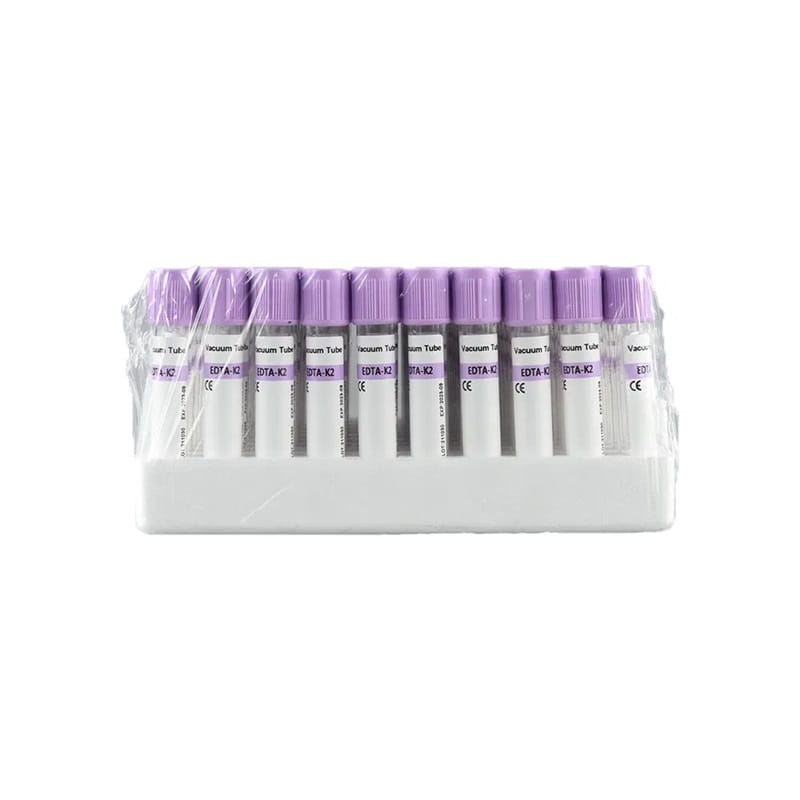
The letters on an EDTA tube matter.
K2EDTA contains dipotassium EDTA, while K3EDTA contains tripotassium EDTA. Both prevent coagulation through calcium chelation, but their physical form and analytical effects may differ.
International hematology recommendations have favored K2EDTA for blood-cell counting and sizing.
Comparative research has also evaluated K2EDTA and K3EDTA tubes. One study comparing plastic K2EDTA and glass K3EDTA collection systems found only small differences for many routine hematology measurements, although some differences reflected known effects associated with liquid K3EDTA.
For modern laboratories, the practical lesson is straightforward.
Do not choose 3 mL EDTA Tubes based solely on volume. Confirm whether the tube contains K2EDTA or K3EDTA and whether that additive matches analyzer instructions and laboratory procedures.
Readers can explore the K2 EDTA blood collection tube specification and the comparison of K2 EDTA vs heparin tubes for further context.
How EDTA Prevents Blood From Clotting
Understanding the chemistry helps explain why EDTA performs well in hematology.
Calcium participates in several stages of blood coagulation. EDTA strongly binds calcium ions, making the calcium unavailable for normal clot formation.
This property is known as chelation.
A detailed scientific review of EDTA’s laboratory role describes its long-standing use as an in-vitro anticoagulant for hematological testing.
For a general chemistry overview, readers can also review ethylenediaminetetraacetic acid and the EDTA Tube explanation of how EDTA in purple-top tubes works.
However, EDTA is not suitable for every blood test.
For example, routine coagulation testing generally requires a citrate tube because the testing method depends on controlled, reversible calcium binding. Therefore, phlebotomists should select tubes according to the requested test rather than choosing EDTA by default.
Correct Collection and Mixing of 3 mL EDTA Tubes
Reliable laboratory results begin before the sample reaches the analyzer.
First, staff should confirm patient identification, requested tests, tube type, additive, expiration date, and required fill level.
After collecting blood into 3 mL EDTA Tubes, the specimen must mix adequately with the anticoagulant. Gentle inversion helps distribute EDTA throughout the blood.
The exact number of inversions should follow the tube manufacturer’s instructions rather than a universal assumption.
Aggressive shaking should be avoided. It does not improve proper anticoagulant mixing and may damage the specimen.
Correct order of draw is equally important when several tubes are collected during one venipuncture.
According to the CLSI order-of-draw guidance, EDTA tubes follow heparin tubes and precede fluoride/oxalate tubes in the standard sequence. The purpose is to reduce additive carryover between specimens.
Laboratories should also establish test-specific limits for storage time and temperature.
Those limits may vary by analyzer and analyte. Therefore, a single storage rule should not be applied blindly to every EDTA-based test.
Can 3 mL EDTA Tubes Be Used for HbA1c?
Some HbA1c analyzers use EDTA-anticoagulated whole blood.
Therefore, 3 mL EDTA Tubes may work for HbA1c testing when the analyzer manufacturer specifically accepts that specimen type.
The EDTA Tube size guide also lists analyzer-dependent HbA1c testing among potential applications of 3 mL tubes.
The important phrase is analyzer-dependent.
Laboratories should verify the instrument’s instructions for use before selecting the collection tube. The fact that one HbA1c system accepts EDTA whole blood does not guarantee that every method accepts the same tube, additive, or storage conditions.
What About ESR Testing?
ESR requires similar caution.
Traditional Westergren ESR testing typically uses a specified anticoagulated specimen system. However, some automated ESR analyzers can work with EDTA whole blood.
As a result, 3 mL EDTA Tubes may support ESR testing only when the specific analyzer and laboratory procedure permit it.
This is a useful example of why a tube should never be assigned to a test merely because another laboratory uses it.
Method validation always comes first.
Blood Grouping and Blood Bank Applications
EDTA whole blood can also appear in immunohematology and blood-bank workflows.
In some settings, 3 mL EDTA Tubes may provide specimens for blood grouping or other pretransfusion procedures. However, specimen volume, labeling, patient identification, sample age, and local transfusion policies require strict control.
Laboratories can review the guide to EDTA purple tubes in blood banking procedures for additional product-oriented background.
Because blood-bank errors can have serious consequences, the receiving laboratory’s validated procedure should always take priority over general tube-selection advice.
When 3 mL EDTA Tubes May Not Be Enough
Smaller volume is beneficial only when it supports the entire testing plan.
A 3 mL specimen may become restrictive when several add-on tests are likely. The same issue can arise when testing requires manual smear preparation, repeat runs, reflex procedures, research aliquots, or referral to another laboratory.
In those circumstances, collecting a larger EDTA tube may prevent a second venipuncture.
Similarly, some molecular tests require more whole blood than a routine CBC. Laboratories should check the assay’s minimum sample volume before using 3 mL EDTA Tubes for DNA extraction, PCR, or other molecular workflows.
The best collection strategy does not automatically favor smaller or larger tubes.
Instead, it matches tube volume to expected analytical demand.
Common Mistakes With 3 mL EDTA Tubes
One common error is assuming that every lavender tube is identical. Staff should verify the additive, manufacturer, fill volume, and intended use.
Another problem is substantial underfilling. Although limited research has shown acceptable results for some underfilled K2EDTA specimens, those findings are method-specific and cannot replace laboratory validation.
Poor mixing can create another problem. If EDTA does not disperse adequately, microclots may develop and compromise cellular analysis.
Laboratories should also investigate unexpected platelet results. EDTA-related platelet clumping can produce falsely low automated platelet counts in susceptible specimens.
Finally, 3 mL EDTA Tubes should not be used simply because their volume seems convenient. The requested assay and validated specimen requirement must determine the collection tube.
For further explanation of tube identification, see why purple color matters in phlebotomy and the guide to EDTA anticoagulant purple-cap function.
Choosing 3 mL EDTA Tubes for a Laboratory
Laboratory buyers should evaluate more than tube capacity.
The additive should come first. Confirm whether the product contains K2EDTA or K3EDTA and whether that formulation matches the laboratory’s testing requirements.
Next, check the nominal draw volume, tube dimensions, material, closure design, labeling, lot traceability, expiration information, and compatibility with existing racks and analyzers.
Procurement teams should also request applicable product documentation and quality information rather than relying only on marketing descriptions.
The EDTA Tube homepage provides access to EDTA collection products and technical guides. Buyers can also examine the EDTA tube product category before comparing available sizes.
For manufacturer information, the SINY Medical EDTA tube page provides product-oriented details. The SINY Medical supplier profile offers additional commercial information, while the SINY Medical YouTube channel contains product and company videos.
Medical and analytical decisions, however, should rely on validated laboratory procedures and recognized professional guidance rather than promotional material.
Summary
3 mL EDTA Tubes make the most sense when a laboratory needs enough EDTA-anticoagulated whole blood for routine testing without collecting a larger specimen unnecessarily.
They are particularly practical for routine CBC workflows, white-cell differential testing, hemoglobin and platelet analysis, and selected analyzer-dependent procedures. Their moderate capacity may also work well in some pediatric and low-volume collection settings.
However, tube size alone does not determine specimen quality.
The laboratory must also control additive type, fill volume, mixing, order of draw, specimen stability, analyzer compatibility, and minimum sample requirements. CLSI emphasizes that correct collection and handling practices are essential because preanalytical errors can affect specimen integrity and the reliability of laboratory results.
For that reason, the best rule is simple: choose the smallest validated tube that provides enough specimen for the complete testing plan.
Laboratories can explore available EDTA blood collection products, review information about EDTA blood anticoagulant tubes, or contact the EDTA Tube team for product specifications.
FAQs
Are 3 mL EDTA Tubes suitable for a CBC?
Yes. 3 mL EDTA Tubes are commonly suitable for CBC testing when the hematology analyzer accepts the available specimen volume. Laboratories should also consider aspiration volume, dead volume, repeat testing, and their validated minimum specimen requirement.
Why choose 3 mL EDTA Tubes instead of 5 mL tubes?
3 mL EDTA Tubes can reduce unnecessary blood collection when a routine hematology request does not require the additional specimen provided by a 5 mL tube. A larger tube remains useful when multiple tests, repeat analysis, or additional procedures are expected.
Can 3 mL EDTA Tubes be used for pediatric patients?
3 mL EDTA Tubes may be appropriate for some pediatric collections when the required tests need more specimen than a very small-volume tube provides. CLSI supports the general use of low-volume collection systems in pediatric phlebotomy to reduce blood volume and address fragile veins.
Can 3 mL EDTA Tubes be underfilled?
Laboratories should normally fill 3 mL EDTA Tubes according to the manufacturer’s intended draw volume. Although research has found acceptable results for some underfilled K2EDTA specimens, the findings depend on the tube, analyzer, parameter, and validation conditions.
Are 3 mL EDTA Tubes suitable for HbA1c testing?
3 mL EDTA Tubes may support HbA1c testing when the specific analyzer accepts EDTA whole blood. Laboratories should confirm the instrument manufacturer’s specimen requirements, minimum volume, stability limits, and storage instructions before routine use.
What is the difference between 3 mL EDTA Tubes and heparin tubes?
3 mL EDTA Tubes use EDTA to chelate calcium and are strongly associated with hematology testing. Heparin tubes use a different anticoagulant mechanism and commonly support plasma-based chemistry and other applications. The tubes should not be treated as interchangeable; see the detailed K2 EDTA versus heparin tube comparison.