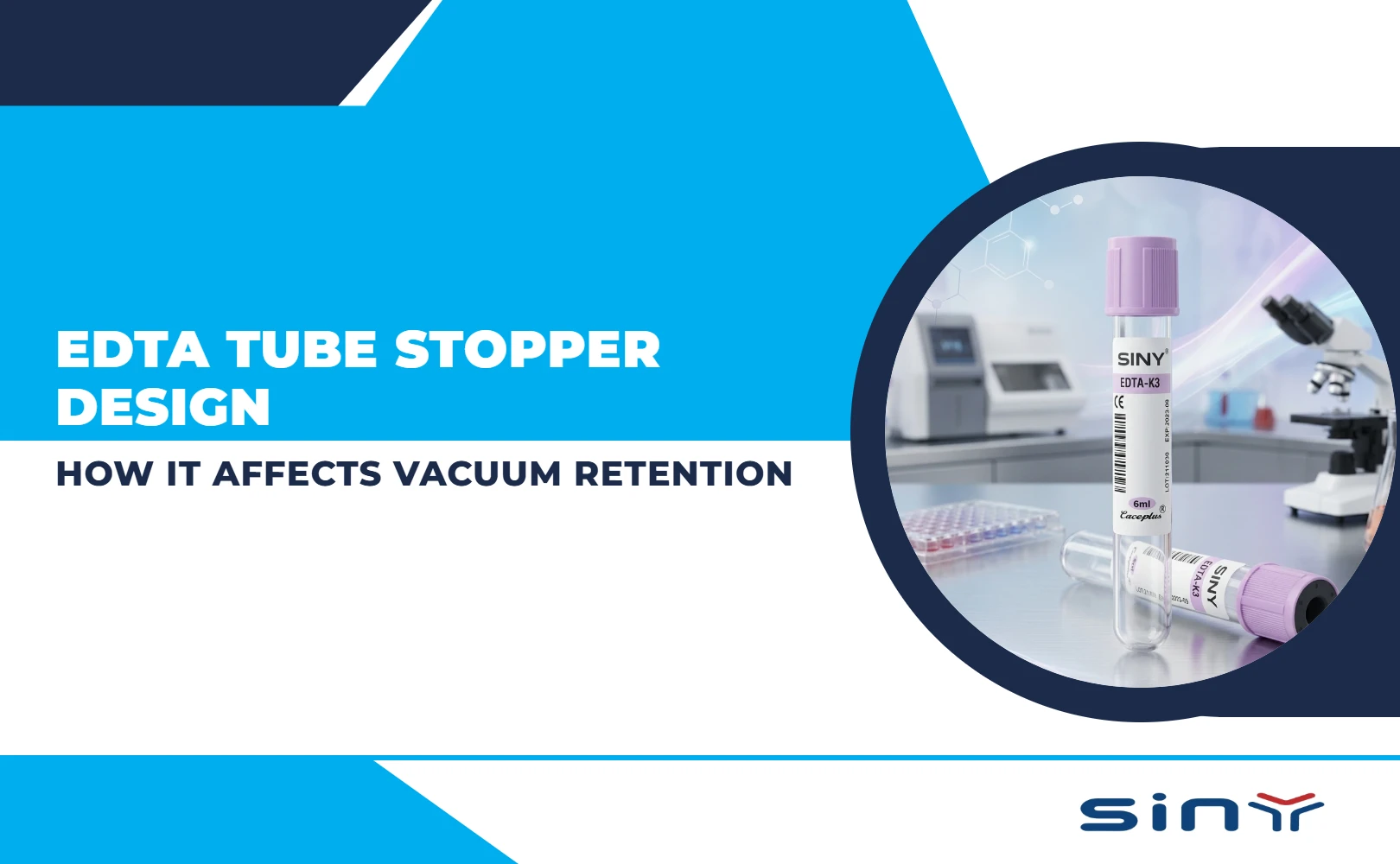
A vacuum tube is only as good as its seal. The stopper holds the vacuum for months on a shelf, lets a needle pass cleanly, and closes again after the draw. If it fails, tubes underfill, leak or open too easily. EDTA tube stopper design is a small detail that decides a lot of everyday quality.
This guide explains how stoppers keep vacuum, which design features matter, and what buyers and labs should check. It is written for lab managers, quality staff and procurement teams. As an EDTA tube manufacturer, SINY tests stoppers and caps as part of lot release, so we share the points that matter most.
Short answer: The stopper keeps vacuum by sealing tightly against the tube and resisting gas passing through the rubber. Good EDTA tube stopper design uses low-permeability rubber such as butyl or bromobutyl, the right fit and compression, a safe cap that keeps the stopper seated, and a puncture zone that reseals after the needle. Weak stoppers lose vacuum faster, causing short draws before expiry.
Key Takeaways
- Vacuum loss over shelf life mostly comes from gas passing through or around the stopper.
- Butyl and bromobutyl rubbers have low gas permeability, which helps vacuum last.
- Fit and compression between stopper and tube wall decide the seal.
- The plastic cap protects the stopper, reduces spatter and helps automation.
- Heat and damage speed up vacuum loss, so storage still matters.
How a Stopper Keeps the Vacuum
When a vacuum tube is made, air is removed and the stopper is pressed into place. From that moment, outside air tries to get back in. It can pass in two ways: around the stopper where it meets the tube wall, or slowly through the rubber itself. Good stopper design limits both. The result is a tube that still draws close to its stated volume at the end of its shelf life.
Tube material plays a role too. Glass is almost gas-tight, while PET lets small amounts of gas through over time. Stopper and tube must be designed together. See EDTA tube components for how the parts work as a system.
Key Features of EDTA Tube Stopper Design
Rubber type
Butyl and bromobutyl rubbers are widely used for blood collection stoppers because they have low gas permeability and good resealing after puncture. The rubber must also be clean, low in extractables and compatible with blood, so it does not interfere with test results.
Shape and fit
The stopper is slightly larger than the tube opening, so it presses against the wall. The amount of compression, the depth of insertion and the shape of the sealing ribs all affect the seal. Too loose, and air enters. Too tight, and the stopper is hard to remove or may split.
Puncture zone
The centre of the stopper is thinner so the needle passes easily. It must reseal after the needle is withdrawn, so blood does not leak during mixing and transport.
Plastic safety cap
Many tubes have a plastic cap over the rubber. It keeps the stopper seated, covers the rubber surface, reduces blood spatter when opening, and gives automated decappers a consistent shape to grip. The cap colour also identifies the additive, lavender for EDTA. See the blood tube color chart.
Opening force
Staff and decappers must be able to remove the cap without force that causes spills. Stopper design balances a strong seal with a reasonable opening force.
How Stopper Problems Show Up in the Lab
| Problem | Likely stopper cause | Effect |
|---|---|---|
| Short draws before expiry | Poor seal or permeable rubber | Wrong blood-to-EDTA ratio |
| Leaks after inversion | Puncture zone does not reseal | Spills, exposure, sample loss |
| Caps popping off | Loose fit or damaged cap | Spill risk in transport |
| Hard to open | Over-compression | Spatter, decapper errors |
| Rubber fragments | Poor rubber quality or needle coring | Possible probe blockage |
Short draws change results. Read underfilled EDTA tubes for details.
How Manufacturers Test Stoppers
- Draw volume tests on each lot and at intervals over shelf life.
- Leak tests under ISO 6710 conditions, including inversion.
- Stability studies to show vacuum holds until expiry.
- Puncture and reseal tests with standard needles.
- Cap removal force checks for manual and automated opening.
- Incoming inspection of rubber and cap materials.
Storage Still Matters
Even a good stopper loses vacuum faster in heat. Store EDTA tube at room temperature, out of direct sun, and avoid crushing cartons. Rotate stock by expiry date. See FIFO vs FEFO for EDTA tubes and EDTA tube shelf life.
What Buyers Should Check
- Rubber type and supplier control for stoppers.
- Draw volume data per lot and stability data up to expiry.
- Leak test results against ISO 6710.
- Cap design and fit with your decappers and analysers.
- Results of your own draw volume test on samples near the start and later in shelf life if possible.
For more buying checks, see our EDTA tube supplier checklist and EDTA tube lot-to-lot variation.
SINY Stoppers and Caps
SINY EDTA tubes use rubber stoppers with protective plastic caps in standard lavender colour, tested for draw volume and leakage on each lot. Browse the EDTA tube range or request samples.
FAQ: EDTA Tube Stopper Design
What are EDTA tube stoppers made of?
Most are made of butyl or bromobutyl rubber, chosen for low gas permeability, good resealing and blood compatibility. A plastic cap often covers the rubber.
Why do vacuum tubes lose vacuum over time?
Small amounts of air pass around the stopper seal and through the rubber and tube wall. Good stopper design slows this so tubes still fill correctly until expiry. Heat speeds it up.
What does the plastic cap on an EDTA tube do?
It keeps the stopper seated, covers the rubber, reduces spatter when opening, identifies the additive by colour and gives automated decappers a consistent grip.
Can a bad stopper cause short draws?
Yes. If the stopper does not seal well, the tube loses vacuum and draws less blood, which changes the blood-to-EDTA ratio and can affect results.
How can I test EDTA tube vacuum?
Draw water through a standard needle and holder into several tubes and measure or weigh the volume. It should be within the stated tolerance of the nominal draw volume.
Summary
EDTA tube stopper design decides how well a tube keeps its vacuum, reseals after puncture and opens safely. Low-permeability rubber, correct fit, a good cap and proper storage keep draw volume accurate until expiry. Ask for draw volume and leak data, and test samples yourself.
To request SINY EDTA tube samples for testing, contact our team.