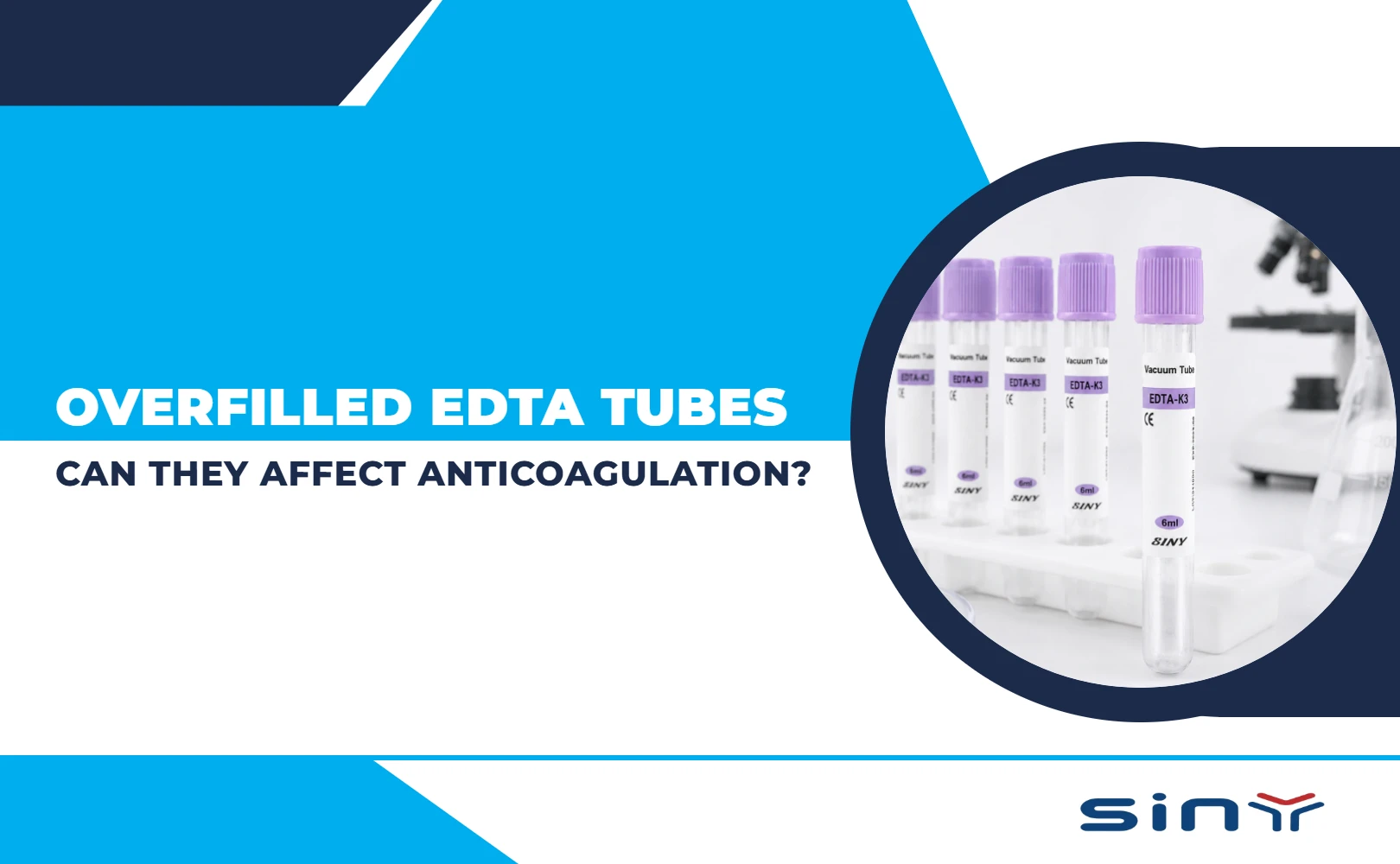
Most fill-volume talk is about short draws. Yet the opposite problem also reaches the lab. Overfilled EDTA tubes hold more blood than the tube was designed for, which leaves too little anticoagulant and too little air space for mixing. The result can be small clots that quietly lower platelet counts or block analyser probes.
This guide explains how overfilling happens, what it does to the sample, and how to prevent it. It is written for phlebotomists, nurses and lab staff. As an EDTA tube manufacturer, SINY designs each tube for a set draw volume, and we often help labs trace clot problems back to fill level.
Short answer: Yes. An overfilled EDTA tube has less EDTA per mL of blood than intended, and little or no air gap to let the blood mix when inverted. Both raise the risk of microclots, which can lower platelet counts, distort white cell results and block analysers. Vacuum tubes rarely overfill on their own; most overfills come from syringe transfers, open tubes or removed caps.
Key Takeaways
- Each tube’s EDTA amount is matched to its stated draw volume, usually around 1.5 to 2.2 mg per mL of blood.
- Extra blood dilutes the EDTA below its target, so anticoagulation can be incomplete.
- The air space above the blood is needed for proper mixing by inversion.
- Overfilling mostly happens with syringe transfer, uncapped tubes and non-vacuum or micro tubes.
- Fill to the line, use the right tube size, and avoid opening vacuum tubes to add blood.
How EDTA Tubes Are Designed to Fill
An EDTA vacuum tube contains a set vacuum and a set amount of EDTA. The vacuum draws a stated volume, and the EDTA is dosed for that volume. ICSH guidance suggests about 1.5 to 2.2 mg of EDTA per mL of blood, and ISO 6710 covers draw volume and additive requirements. The fill line on the label shows the intended level.
The space above the blood also matters. When the tube is turned upside down, the air bubble travels through the blood and mixes it with the additive. Without that bubble, inversion moves the blood very little.
How Overfilling Happens
Syringe transfer
When blood is drawn with a syringe and pushed into a tube, staff may add more than the stated volume, especially if they remove the cap. Pushing blood hard through a needle can also cause haemolysis.
Removing the cap of a vacuum tube
Once a vacuum tube is opened, its volume control is lost. Topping up an open tube almost always leads to overfill.
Non-vacuum and micro tubes
Open tubes for capillary or syringe collection rely on staff to fill to the mark. Without care, they are easy to overfill. See non-vacuum blood collection tubes and micro EDTA tubes.
Wrong tube size
Using a small tube for a test that needs more blood tempts staff to squeeze in extra. Choose the right draw volume instead. Read EDTA tube sizes explained.
What Overfilling Does to the Sample
| Problem | Why it happens | Possible effect on results |
|---|---|---|
| Low EDTA per mL | Extra blood dilutes the fixed EDTA dose | Incomplete anticoagulation, small clots |
| Poor mixing | No air bubble to move blood during inversion | EDTA not spread evenly; microclots |
| Microclots | Clotting starts where EDTA did not reach | Falsely low platelets, possible WBC errors, probe blockage |
| Leakage | Blood pressed against the stopper | Spill risk, contamination, staff exposure |
| Haemolysis | Forceful syringe transfer | Can interfere with some measurements |
Clots caught in a sample can lower the platelet count and sometimes trigger analyser flags. Small clots may not be visible without careful inspection. For related causes, read preanalytical errors in EDTA samples.
Overfilled vs Underfilled EDTA Tubes
| Factor | Underfilled | Overfilled |
|---|---|---|
| EDTA per mL | Too high | Too low |
| Main risk | Cell shrinkage, low HCT and MCV | Microclots, low platelets |
| Usual cause | Early removal, lost vacuum | Syringe transfer, open tubes |
| Mixing | Easy | Difficult |
Both are fill-volume errors. Read underfilled EDTA tubes for the other side.
How Labs Handle Overfilled EDTA Tubes
- Check fill level against the fill line on arrival.
- Inspect for clots by gently tilting the tube or using applicator sticks, following local procedure.
- Reject or flag clotted samples and request a new draw.
- Review a smear if platelet counts look unexpectedly low.
- Record repeat problems by site, so training can target the cause.
How to Prevent Overfilling
- Use vacuum tubes with a holder whenever possible, and let the vacuum control the volume.
- Never remove the cap of a vacuum tube to add blood.
- When syringe transfer is needed, use a transfer device and let the vacuum draw the blood.
- Fill open tubes only to the marked line.
- Choose a larger draw volume tube if more blood is needed.
- Invert gently 8 to 10 times right after filling. See EDTA tube inversion.
- Include fill level in phlebotomy training and audits.
The Role of Tube Design
A tube with accurate vacuum, a clear fill line and enough head space makes correct filling easy. When you choose a supplier, check draw volume data per lot and test samples on your own workflow. Our EDTA tube components guide explains how vacuum and labels work together.
EDTA Tubes from SINY
SINY makes vacuum EDTA tubes from 2 mL to 10 mL and non-vacuum EDTA tubes for syringe and capillary use, each with a clear fill line. Browse the EDTA tube range or request samples.
FAQ: Overfilled EDTA Tubes
What happens if an EDTA tube is overfilled?
The EDTA is spread over more blood than intended, so there is less anticoagulant per mL, and there is little air space for mixing. This can lead to microclots, falsely low platelet counts and analyser errors.
Can a vacuum EDTA tube overfill on its own?
Rarely. The vacuum limits how much blood enters. Most overfills happen when the cap is removed, when blood is pushed in from a syringe, or with open non-vacuum and micro tubes.
Why does an EDTA tube need air space?
When the tube is inverted, the air bubble moves through the blood and mixes it with the EDTA. Without that space, mixing is poor and clots can form.
Should labs reject overfilled EDTA tubes?
Many labs check overfilled tubes for clots and reject clotted samples. Local rules decide whether an overfilled tube without visible clots can be tested.
How do I avoid overfilling during syringe draws?
Use a blood transfer device so the tube vacuum draws the blood, rather than removing the cap or pushing blood in by hand.
Summary
Overfilled EDTA tubes carry too little EDTA for the blood and too little air for mixing. That raises the risk of microclots and wrong platelet counts. Let the vacuum control volume, avoid opening tubes, use transfer devices and choose the right tube size.
For EDTA tubes with accurate draw volume and clear fill lines, contact the SINY team.