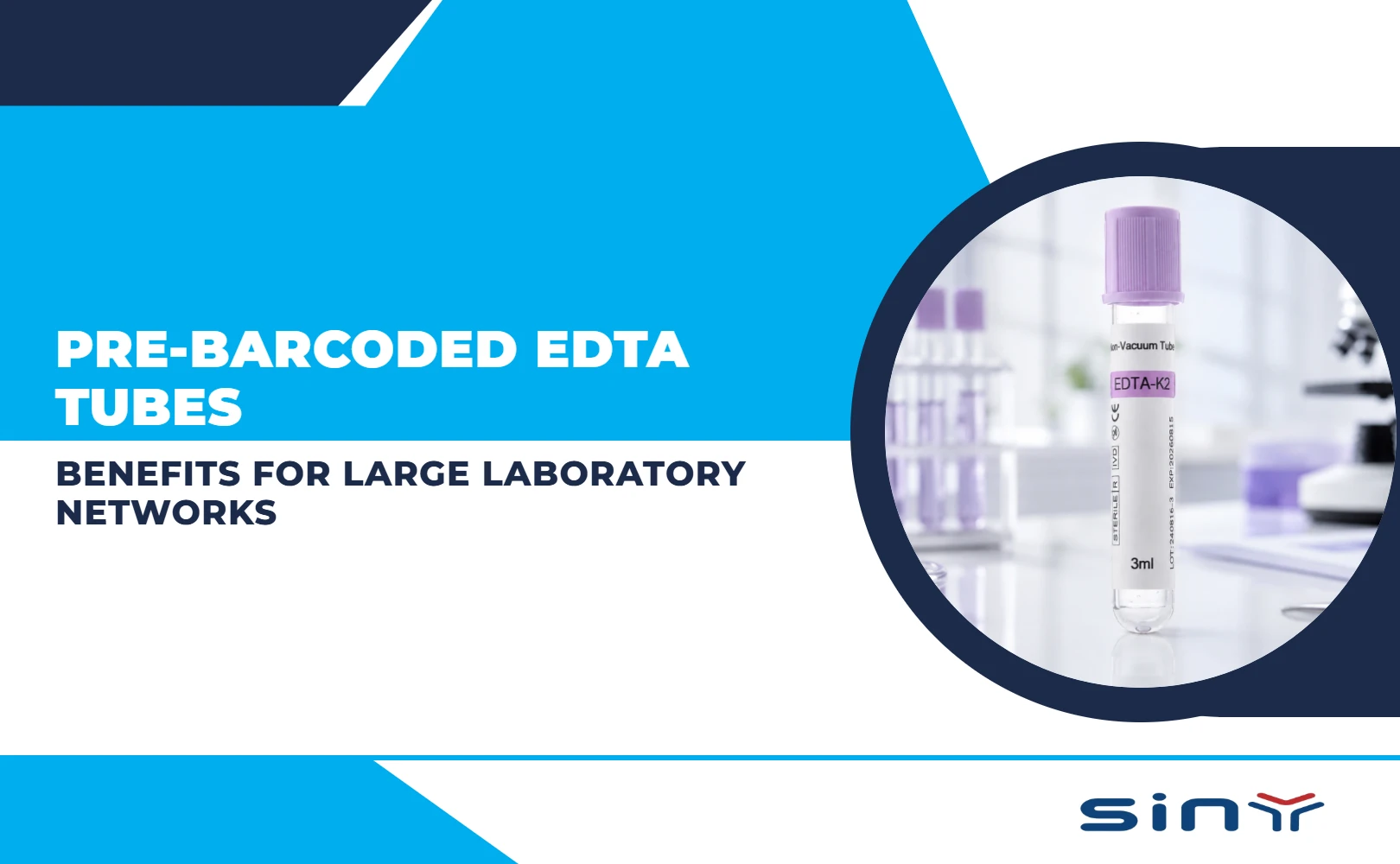
In a busy collection centre, every tube needs a label before or after the draw. Staff print it, peel it, stick it on straight and hope the scanner reads it. Multiply that by thousands of tubes a day across many sites and errors are certain. Pre-barcoded EDTA tubes remove part of that work by arriving with a unique barcode already printed on each tube.
This guide explains how pre-barcoded tubes work, where they help, and what a lab network must check before switching. It is written for lab directors, IT and LIS teams, and procurement staff. As an EDTA tube manufacturer, SINY gets more requests for barcode-ready labels each year, mostly from large networks and home-collection services.
Short answer: Pre-barcoded EDTA tubes have a unique, factory-printed barcode on each tube. At collection, staff scan the tube and link it to the patient order in the laboratory information system (LIS), instead of printing and sticking a label. This saves time, reduces label errors and suits remote and high-volume collection, but needs LIS support and agreed barcode formats.
Key Takeaways
- Each tube carries a unique ID that the LIS links to the patient at collection.
- Pre-barcoding reduces label printing, crooked labels and wrong-tube mistakes.
- It suits large networks, mobile phlebotomy, home collection and clinical trials.
- Barcode format, print quality, position and number range must be agreed with the maker.
- Run a pilot with your LIS and analysers before a full switch.
How Pre-Barcoded EDTA Tubes Work
With standard tubes, the lab prints a patient barcode label and sticks it on the tube. With pre-barcoded tubes, each tube already carries a unique code printed during manufacture. The workflow becomes:
- The order is created in the LIS or collection app.
- The phlebotomist scans the patient ID and then the tube barcode.
- The system links that tube number to the patient and the order.
- The analyser reads the tube barcode and pulls the order from the LIS.
The tube still shows the patient name if local rules require it, often on a small extra label or written field. The barcode itself is just a unique number.
Benefits for Large Laboratory Networks
Fewer identification errors
Patient ID errors are among the most serious preanalytical mistakes. Factory-printed barcodes are straight, sharp and in the same place every time, so scanners read them first time. Linking happens at the bedside, which reduces mix-ups from pre-printed labels. See preanalytical errors in EDTA samples for the wider picture.
Faster collection
Staff skip the printing and labelling step. In high-volume centres, saving a few seconds per tube adds up to hours per day.
Better scanning on automated lines
Hand-applied labels can wrinkle, overlap or cover the sample window. Pre-printed codes sit in a fixed position that suits track systems and analysers. Read automation in blood collection for how lines read tubes.
Remote and home collection
Mobile teams and home-collection services often have no printer. Pre-barcoded tubes and a phone app let them link tubes on site and ship to the central lab with full traceability.
Clinical trials and research
Studies often use kits with pre-coded tubes. Each tube ID links to a subject and a visit, which supports chain of custody.
Pre-Barcoded vs Standard Labelled EDTA Tubes
| Factor | Standard tubes | Pre-barcoded tubes |
|---|---|---|
| Label printing at site | Needed | Not needed for the barcode |
| Label position | Varies by staff | Fixed |
| Scan rate | Depends on label quality | High and consistent |
| LIS change | None | Must support tube-ID linking |
| Unit cost | Lower | Higher |
| Best for | Small sites, low volume | Networks, remote collection, trials |
What to Agree with the Manufacturer
Barcode symbology
Code 128 is the most common linear barcode in labs. Some systems use 2D codes such as Data Matrix, which hold more data in less space. Confirm what your LIS, scanners and analysers read.
Number format and ranges
Agree the number length, prefix and check digit, and reserve a unique range for your network. Codes must never repeat. Ask how the maker controls ranges between orders.
Print quality
Ask how print quality is checked, for example with a grading standard such as ISO/IEC 15416 for linear barcodes. The code must stay readable after cold storage, alcohol wipes and centrifuging.
Position and label size
The barcode must sit where your analysers read, with enough quiet zone, and leave a clear window for checking the sample. Share your analyser specs with the maker. See EDTA tube dimensions for tube sizes.
Human-readable text
Print the number in plain text under the code, so staff can type it if a scanner fails.
Steps to Switch to Pre-Barcoded EDTA Tubes
- Confirm LIS support for tube-ID linking at collection.
- Agree barcode format, ranges, position and print checks with the maker.
- Order pilot tubes and test scanning on every analyser and reader.
- Run a pilot at one or two sites for a few weeks.
- Train staff and update collection procedures.
- Roll out site by site and monitor scan failures and ID errors.
Treat the pilot like any tube change. Our guide to EDTA tube sample orders explains how to test and approve samples.
Cost and Order Planning
Pre-barcoded tubes cost more per unit because of printing, data control and smaller runs. Networks usually recover this through saved staff time, fewer printers and labels, and fewer recollections. Order volumes and lead times also differ from standard stock. Discuss minimum order sizes early. See EDTA tube wholesale price for general cost drivers.
Barcode-Ready Tubes from SINY
SINY can supply EDTA tubes with custom labels and barcode areas for lab networks and private label buyers. Share your LIS and analyser requirements, and our team will advise on label layout and sample runs. Browse the EDTA tube range or read about private label EDTA tubes.
FAQ: Pre-Barcoded EDTA Tubes
What are pre-barcoded EDTA tubes?
They are EDTA blood collection tubes with a unique barcode printed on each tube during manufacture. At collection, staff scan the tube and link it to the patient order in the LIS, instead of printing a label.
Are pre-barcoded tubes worth the extra cost?
For large networks, mobile teams and clinical trials, often yes. Savings in staff time, labels, printers and recollections can outweigh the higher unit price. For small, low-volume sites, standard tubes are usually enough.
Which barcode type is used on blood tubes?
Code 128 is the most common linear barcode in labs. Some systems use 2D Data Matrix codes. Check what your LIS, scanners and analysers support before ordering.
Does my LIS need to support pre-barcoded tubes?
Yes. The LIS or collection app must let staff link a tube ID to a patient and order at collection. Most modern systems can do this, but confirm with your vendor.
Can pre-barcoded tubes still carry the patient name?
Yes. Many labs add a small name label or write on a field, depending on local rules. The barcode stays as the unique tube ID.
Summary
Pre-barcoded EDTA tubes give every tube a unique, factory-printed ID. For large networks they cut label errors, speed up collection and improve scanning. Success depends on LIS support, agreed barcode formats and a careful pilot.
To discuss barcode-ready EDTA tubes for your network, contact the SINY team.