Choosing a blood collection tube should never come down to cap color or tube size alone. The laboratory also needs to consider the anticoagulant, expected test menu, analyzer requirements, fill volume, and possible repeat testing.
For many adult hematology workflows, 5 mL EDTA Tubes provide a generous whole-blood specimen without moving into the largest available collection sizes. They can be especially useful when a laboratory expects more than one hematology procedure from the same sample.
EDTA, or ethylenediaminetetraacetic acid, prevents blood from clotting by binding calcium ions that are needed during coagulation. FDA documentation for EDTA blood collection systems describes this calcium-binding mechanism and recognizes K2EDTA and K3EDTA vacuum collection tubes as anticoagulant blood collection devices.
International hematology recommendations have also identified dipotassium EDTA, commonly called K2EDTA, as the anticoagulant of choice for blood-cell counting and sizing.
A 5 mL tube, however, is not automatically better than a 3 mL or 4 mL option. The best tube is the one that provides enough validated specimen for the complete testing plan without collecting unnecessary blood.
Laboratories comparing available products can start with the EDTA Tube product catalog or review the dedicated EDTA blood collection tube category.
What Are 5 mL EDTA Tubes?
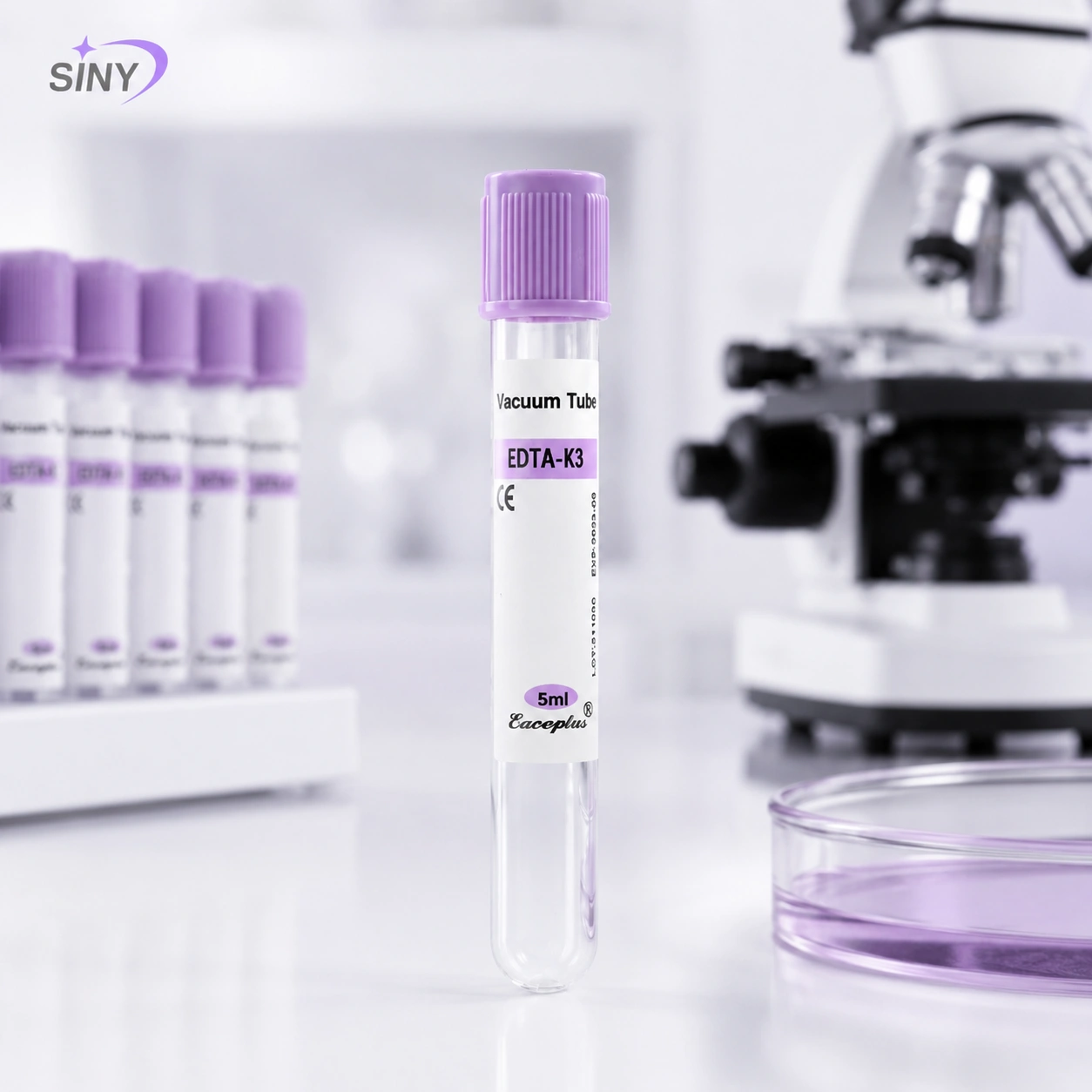
5 mL EDTA Tubes are blood collection tubes designed to collect approximately five milliliters of whole blood while exposing the specimen to a measured quantity of EDTA anticoagulant.
Depending on the product, the additive may be K2EDTA or K3EDTA. Both forms prevent clot formation by chelating calcium, but their formulation and laboratory use can differ. FDA records list both K2EDTA and K3EDTA vacuum blood collection systems within the anticoagulant tube category.
The 5 mL format sits above the smaller 2 mL, 3 mL, and 4 mL tubes commonly used in routine hematology. It provides extra specimen when the laboratory anticipates repeat testing, additional blood-film preparation, analyzer troubleshooting, or another compatible assay.
The EDTA tubes for blood collection product page lists EDTA tube volumes from 2 mL through 10 mL and includes 5 mL configurations using K2EDTA or K3EDTA.
For laboratories specifically seeking a five-milliliter format, EDTA Tube also lists a 5 mL K2 EDTA blood collection tube and a dedicated 5 mL K2 EDTA vacuum blood collection tube.
Why 5 mL EDTA Tubes Can Be a Practical Choice
A larger specimen gives a laboratory more working room.
A modern hematology analyzer may need only a relatively small portion of the sample for its first aspiration. Yet the total specimen requirement is not determined by aspiration volume alone.
The laboratory may need to repeat a CBC. An analyzer may produce a flag. A blood film may need preparation. Another validated hematology procedure may also be requested.
In those situations, 5 mL EDTA Tubes can reduce the risk of running out of usable specimen.
That does not mean routine hematology always needs five milliliters.
For comparison, CDC NHANES complete blood count procedures have used 3 mL or 4 mL K2EDTA specimens for standardized CBC testing.
This is an important selection lesson. A standard CBC does not inherently require a 5 mL draw. The larger tube becomes useful when workflow needs justify the additional specimen.
Common Uses of 5 mL EDTA Tubes
Complete Blood Count Testing
One of the most common applications for 5 mL EDTA Tubes is complete blood count testing.
A CBC evaluates the cellular components of blood. Depending on the analyzer and laboratory report, results may include white blood cell count, red blood cell count, platelet count, hemoglobin, hematocrit, and several calculated red-cell indices.
EDTA is widely used for this work because it keeps the blood anticoagulated while supporting cellular analysis. International hematology guidance specifically recommends K2EDTA for blood-cell counting and sizing.
Although 5 mL may exceed the minimum volume needed for a routine CBC, the extra specimen can help when a second run or additional procedure is likely.
The 5 mL K2 EDTA tube product page also identifies CBC, WBC, RBC, and platelet testing among its intended hematology applications.
White Blood Cell Differential
A CBC with differential evaluates both the total white blood cell count and the distribution of major leukocyte groups.
Depending on the analyzer, these commonly include neutrophils, lymphocytes, monocytes, eosinophils, and basophils.
5 mL EDTA Tubes may be convenient when a CBC and differential are performed together because the same anticoagulated specimen can support the validated analyzer workflow.
If the instrument reports an unusual distribution or abnormal-cell flag, laboratory staff may need to examine the specimen further.
That is one area where additional sample volume can become useful.
Red Blood Cell Parameters
Routine hematology also evaluates red blood cells and related measurements.
These can include RBC count, hemoglobin concentration, hematocrit, mean corpuscular volume, mean corpuscular hemoglobin, mean corpuscular hemoglobin concentration, and red-cell distribution width.
K2EDTA has been recommended for cell counting and sizing because it supports the measurement of cellular blood components.
Therefore, 5 mL EDTA Tubes can fit adult hematology workflows where CBC testing and possible follow-up measurements are expected.
Platelet Counts
Platelet measurement is another standard use of EDTA-anticoagulated blood.
However, platelet testing comes with an important laboratory limitation.
Some patients show EDTA-dependent platelet clumping in vitro. The platelets aggregate after the blood contacts EDTA, which may cause an analyzer to report a falsely low platelet count.
Research comparing alternative anticoagulants has documented K2EDTA-induced platelet clusters in affected specimens.
Therefore, an unexpectedly low platelet result combined with a platelet-clump flag may require smear review or recollection using the laboratory’s validated procedure.
This issue does not make 5 mL EDTA Tubes unsuitable for routine platelet testing. It simply shows why abnormal results require professional interpretation.
5 mL EDTA Tubes for Peripheral Blood Smear Work
Automated analyzers can perform large numbers of blood counts quickly. Yet microscopic examination remains important in selected cases.
A peripheral blood smear may help investigate abnormal cell morphology, unusual differential results, platelet clumping, immature cells, or analyzer flags.
In such workflows, 5 mL EDTA Tubes provide a useful reserve after the automated CBC has been completed.
The benefit is practical rather than analytical. Five milliliters does not automatically create a better blood smear than a smaller properly collected specimen.
Timing and handling matter more.
Cell morphology can change during prolonged storage. Therefore, laboratories should follow their validated time limits for preparing and examining blood films.
Choosing Between 3 mL, 4 mL, and 5 mL EDTA Tubes
Laboratories often ask whether they should standardize on one EDTA tube volume.
That approach is convenient, but it is not always optimal.
Different patient groups and testing plans can justify different tube sizes.
| EDTA Tube Size | Typical Workflow Fit | Main Advantage | Main Limitation |
|---|---|---|---|
| 3 mL | Routine low-to-moderate volume hematology | Reduces unnecessary blood collection | Less reserve for repeats |
| 4 mL | Standard CBC and routine adult hematology | Good balance between volume and reserve | May still be limited for several add-ons |
| 5 mL | Routine hematology with repeat or additional testing potential | Provides more working specimen | May collect more blood than a simple CBC requires |
CDC procedures demonstrate that 3 mL and 4 mL K2EDTA tubes can support standardized CBC testing, so laboratories should not interpret larger volume as inherently more accurate.
For a closer look at smaller formats, see the guide to 3 mL EDTA Tubes and the comparison of 2 mL and 3 mL EDTA tube sizes.
A practical selection rule is simple:
Use the smallest validated tube that still provides enough specimen for initial testing, likely repeats, and foreseeable add-on procedures.
Why Fill Volume Matters in 5 mL EDTA Tubes
A 5 mL label does not mean the tube can be filled with any quantity of blood without consequence.
The EDTA inside the tube is designed to work with an intended blood volume. Significant underfilling increases the relative amount of EDTA compared with the collected blood.
International hematology recommendations have described approximately 1.5–2.2 mg of dipotassium EDTA per milliliter of blood for cell counting and sizing.
This ratio matters because excessive EDTA exposure can influence cellular measurements.
A study evaluating underfilled K2EDTA collection tubes compared lower specimen volumes with a standard fill. Many parameters showed acceptable agreement under the study conditions, but platelet counts demonstrated increasing negative bias as fill volume decreased.
The study did not establish a universal rule for every EDTA tube or analyzer.
Therefore, laboratories should fill 5 mL EDTA Tubes according to the manufacturer’s intended draw and validate any minimum acceptable volume locally.
K2EDTA vs K3EDTA: Which Should You Choose?
Choosing the correct EDTA salt matters as much as choosing the correct tube volume.
K2EDTA is dipotassium EDTA. K3EDTA is tripotassium EDTA.
Both chelate calcium and prevent coagulation. FDA device records recognize both K2EDTA and K3EDTA blood collection tubes.
However, international hematology recommendations have historically favored K2EDTA for blood-cell counting and sizing.
For that reason, laboratories often select K2EDTA for routine CBC workflows.
The K2 EDTA blood collection tube range provides one example of this tube category, while EDTA Tube also lists a separate 5 mL K3 EDTA vacuum blood collection tube. The product listing identifies the 5 mL K3EDTA format primarily with hematology testing.
The correct choice should ultimately follow analyzer instructions, assay requirements, laboratory validation, and applicable standards.
How EDTA Works Inside the Tube
The chemistry behind 5 mL EDTA Tubes is straightforward.
Calcium plays an essential role in the coagulation cascade. EDTA is a chelating agent, meaning it binds certain metal ions very strongly.
When EDTA binds calcium in the blood specimen, the calcium is no longer freely available for normal clot formation.
FDA documentation describes EDTA blood collection systems as anticoagulant devices that act through calcium chelation.
Readers interested in general chemical background can also review ethylenediaminetetraacetic acid.
The EDTA Tube guide explaining why EDTA tubes are purple provides additional product-oriented context about tube identification.
5 mL EDTA Tubes Are Not Suitable for Every Blood Test
A common selection mistake is treating an EDTA tube as a general-purpose blood collection tube.
It is not.
5 mL EDTA Tubes are strongly associated with hematology because EDTA preserves anticoagulated whole blood for cellular testing.
Routine coagulation studies generally use sodium citrate rather than EDTA because the testing process requires a controlled citrate-to-blood relationship.
Many chemistry procedures may use serum or heparinized plasma instead.
That is why tube selection must follow the requested test.
Readers comparing anticoagulants can review K2 EDTA vs heparin tubes for a practical overview.
Correct Collection and Mixing
Even the correct tube can produce a poor specimen if collection technique fails.
Before collection, staff should verify patient identification, requested tests, tube type, additive, expiration date, and intended fill volume.
After filling 5 mL EDTA Tubes, blood needs adequate contact with the anticoagulant.
Manufacturer instructions for a SINY 5 mL K2EDTA product specify gentle inversion after collection to mix the blood with EDTA.
The exact number of inversions should follow the instructions supplied with the specific tube rather than a universal assumption.
Aggressive shaking should also be avoided.
Proper gentle mixing is intended to distribute anticoagulant throughout the specimen, while rough handling can compromise sample quality.
Where EDTA Fits in the Order of Draw
When several blood tubes are collected during the same venipuncture, the sequence matters.
CLSI explains that the order of draw reduces the risk of additive carryover between tubes. Its published sequence places EDTA after heparin tubes and before sodium fluoride/potassium oxalate tubes.
The standard order described by CLSI is:
blood culture, citrate, serum, heparin, EDTA, and finally glycolytic-inhibitor tubes.
Therefore, 5 mL EDTA Tubes should occupy the appropriate EDTA position during a multi-tube collection.
Correct order of draw supports specimen quality and reduces avoidable preanalytical error.
Storage and Specimen Stability
Five milliliters of specimen does not help if the blood is stored incorrectly.
Cellular blood components can change with time and temperature. The acceptable storage interval also varies according to the parameter, analyzer, and downstream procedure.
For this reason, laboratories should not apply one universal stability rule to every EDTA specimen.
Instead, 5 mL EDTA Tubes should be transported and stored according to the analyzer manufacturer’s instructions and the laboratory’s validated procedure.
A tube supplier may provide general storage guidance for unused tubes. For example, the SINY 5 mL K2EDTA product page lists storage conditions for the collection device itself.
However, unused-tube storage and collected-specimen stability are different issues.
The analytical laboratory should define specimen stability based on the actual test method.
Can 5 mL EDTA Tubes Be Used for Molecular Testing?
EDTA whole blood is used in some molecular and genetic workflows.
However, this does not mean every molecular assay should use 5 mL EDTA Tubes.
Some PCR, DNA extraction, or viral-load procedures accept EDTA whole blood. Others specify a particular collection device, additive, volume, processing method, or storage condition.
The SINY product page lists molecular diagnostics and genetic studies among potential applications of its 5 mL K2EDTA product.
That product information should be treated as a starting point rather than universal assay guidance.
Before using a 5 mL EDTA specimen for molecular testing, the laboratory should confirm the assay’s official specimen requirements.
When a 5 mL EDTA Tube May Be Too Large
There are situations where 5 mL EDTA Tubes do not offer a meaningful advantage.
A basic CBC on a validated analyzer may require far less blood than five milliliters.
For children, patients with fragile veins, or people undergoing frequent blood draws, collecting unnecessary volume is undesirable.
CLSI specifically recommends low-volume collection tubes in pediatric phlebotomy when appropriate because they can reduce both blood volume and vacuum pressure on fragile veins.
In these situations, a 2 mL, 3 mL, or other validated low-volume tube may be more appropriate.
The additional capacity of a 5 mL tube only makes sense when the laboratory expects to use that additional specimen.
When a 5 mL EDTA Tube May Be the Better Option
The larger format becomes more attractive when the workflow is less predictable.
For example, an analyzer may generate abnormal flags that lead to repeat testing or smear preparation.
A laboratory may also have a validated testing pathway that uses the same EDTA sample for more than one compatible hematology procedure.
In those cases, 5 mL EDTA Tubes provide more reserve than a smaller tube.
The key advantage is operational flexibility.
The key disadvantage is potentially unnecessary blood collection.
A good laboratory policy balances both considerations.
Selecting 5 mL EDTA Tubes for Purchasing
Procurement teams should avoid choosing tubes on price alone.
The first question should be whether the laboratory needs K2EDTA or K3EDTA.
Next, confirm nominal draw volume, tube material, closure type, sterility status where applicable, shelf life, labeling, lot traceability, and compatibility with collection equipment.
The 1–10 mL K2 EDTA vacuum blood collection range lists several volume options for laboratories that require different collection sizes.
For direct 5 mL comparison, buyers can review the 5 mL K2 EDTA tube, the 5 mL K2 EDTA vacuum tube, and the 5 mL K3 EDTA vacuum tube.
SINY’s broader EDTA tube information page can be used for manufacturer background. Commercial buyers can also review the SINY Medical supplier profile or view product demonstrations through the SINY Medical YouTube channel.
These manufacturer and commercial resources are useful for product research, but clinical suitability should still be confirmed through validated laboratory procedures and authoritative standards.
Common Selection Mistakes to Avoid
One mistake is assuming that more specimen always improves laboratory quality.
It does not.
Another is choosing 5 mL EDTA Tubes simply because five milliliters feels like a safe amount. The correct volume should reflect actual testing needs.
Underfilling also creates risk because it changes the relative EDTA concentration. Research on K2EDTA tubes has shown that lower fill volumes can influence some hematology parameters, particularly platelet results.
Using the wrong EDTA salt can create another problem if the laboratory has validated only one tube type.
Finally, staff should never use cap color as the sole identifier.
The tube label, additive, intended volume, manufacturer instructions, and test procedure should determine whether the specimen is appropriate.
Frequently Asked Questions About 5 mL EDTA Tubes
Are 5 mL EDTA Tubes suitable for CBC testing?
Yes. 5 mL EDTA Tubes can support CBC testing when the tube additive and analyzer requirements match the laboratory’s validated procedure. However, five milliliters may exceed the minimum volume required for a basic CBC, so laboratories should avoid collecting unnecessary blood.
Why choose 5 mL EDTA Tubes instead of 3 mL or 4 mL tubes?
5 mL EDTA Tubes provide more reserve specimen for repeat analysis, smear preparation, or other compatible procedures. A smaller tube may be preferable when the laboratory needs only a routine CBC and does not expect additional testing.
Should 5 mL EDTA Tubes contain K2EDTA or K3EDTA?
Many hematology laboratories prefer K2EDTA because international recommendations have identified it as the anticoagulant of choice for cell counting and sizing. 5 mL EDTA Tubes containing K3EDTA also exist, but the laboratory should select the additive required by its validated method.
Can 5 mL EDTA Tubes be underfilled?
5 mL EDTA Tubes should normally fill to the manufacturer’s intended draw volume. Significant underfilling changes the anticoagulant-to-blood relationship, and research has shown that underfilled K2EDTA tubes can affect some hematology measurements.
Can 5 mL EDTA Tubes be used for molecular testing?
Some molecular procedures accept EDTA whole blood, so 5 mL EDTA Tubes may be suitable when the assay specifically permits that specimen. Laboratories should confirm additive type, minimum volume, transport, processing, and storage requirements before use.
Are 5 mL EDTA Tubes appropriate for pediatric patients?
5 mL EDTA Tubes may collect more blood than necessary for many pediatric tests. CLSI recommends considering low-volume collection systems for children when appropriate, so the tube size should match the child’s clinical needs and the laboratory’s validated minimum volume.
Summary
5 mL EDTA Tubes can be a practical choice when a laboratory needs a larger EDTA-anticoagulated whole-blood specimen for routine hematology and possible follow-up work.
They can support CBC testing, blood cell counts, differentials, platelet analysis, and other validated EDTA-based procedures.
Their main advantage is the extra specimen available for repeats or additional compatible testing.
However, five milliliters is not automatically the ideal volume for every patient or every CBC. CDC procedures show that smaller 3 mL and 4 mL K2EDTA tubes can support standardized CBC workflows, while CLSI encourages lower-volume collection when clinically appropriate.
The most reliable selection strategy is therefore straightforward:
Choose the smallest validated EDTA tube that provides enough blood for the complete expected laboratory workflow.
For purchasing or technical information, explore the EDTA Tube homepage, browse available EDTA tube products, or contact EDTA Tube for product specifications.