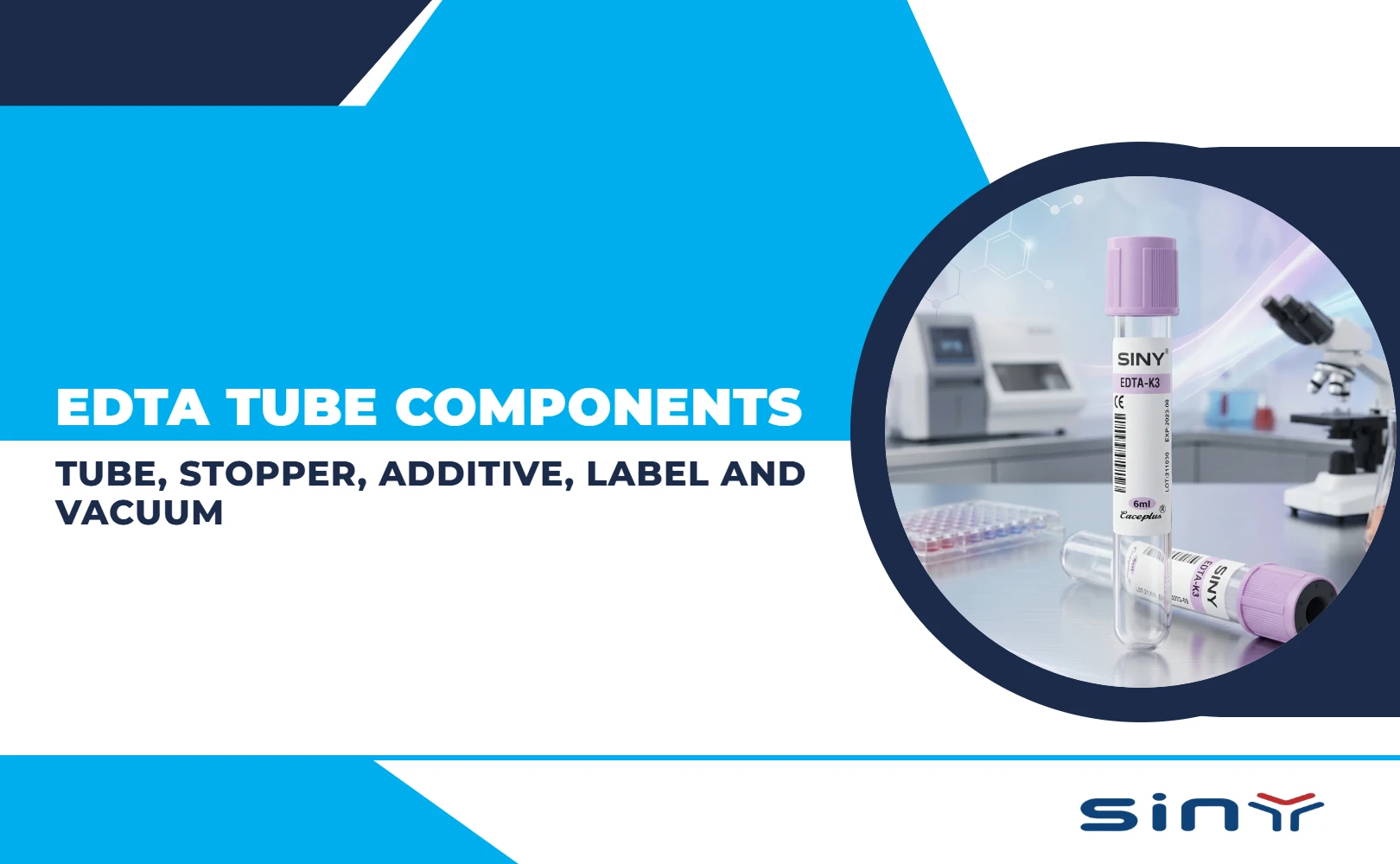
An EDTA tube looks simple: a plastic tube with a lavender cap. In fact it is a small system of parts that must work together. If one part is weak, the sample suffers. Knowing the EDTA tube components helps lab staff spot problems and helps buyers write better specifications.
This guide walks through each part, what it does, and what to check when you compare suppliers. It is written for lab managers, phlebotomy trainers and procurement teams. As an EDTA tube manufacturer, SINY controls each of these parts in production, so we explain them from the factory side.
Short answer: An EDTA vacuum tube has five main components: the tube body (PET plastic or glass), the stopper and cap that seal the vacuum, the EDTA additive (usually spray-dried K2EDTA or liquid K3EDTA), the label with fill line and lot details, and the vacuum that pulls a set volume of blood. Each part affects draw volume, sample quality and analyser fit.
Key Takeaways
- The tube body sets size, strength and clarity; PET plastic is now the most common material.
- The stopper keeps the vacuum and lets the needle pass without leaking; the cap colour identifies the additive.
- The EDTA additive amount is matched to the draw volume, so fill level matters.
- The label carries the fill line, lot number and expiry, and must stay readable on analysers and in cold storage.
- Vacuum decides the draw volume and slowly falls over shelf life.
1. The Tube Body
Material: PET plastic or glass
Most EDTA tubes today are made of PET (polyethylene terephthalate). PET is light, clear and hard to break, which makes it safer for staff and cheaper to ship. Glass tubes are still used in some markets. Glass holds vacuum very well but breaks more easily. For a full comparison, read glass vs plastic EDTA tubes.
Size and wall
Common sizes are 13×75 mm, 13×100 mm and 16×100 mm. The size must fit racks, centrifuges and analysers. The wall must be strong enough to survive centrifuging and transport. See EDTA tube dimensions for typical volumes per size.
Clarity
A clear tube lets staff check fill level, clots and haemolysis at a glance. Cloudy or scratched tubes make that harder.
2. The Stopper and Cap
Rubber stopper
The stopper is usually made of butyl or bromobutyl rubber. It seals the vacuum during storage and closes again after the needle is removed. A good stopper does not shed rubber particles and does not leak when the tube is inverted.
Plastic safety cap
Many tubes have a plastic cap over the stopper. The cap covers the rubber, reduces blood spatter when opened, and makes the tube easier to grip. It must also fit automated decappers if the lab uses them.
Cap colour
EDTA tubes use a lavender or purple cap. Pink caps are used for blood bank EDTA tubes, and royal blue with a lavender band is used for trace elements in some systems. ISO 6710 includes colour coding guidance. Our blood tube color chart shows the full system.
3. The EDTA Additive
EDTA (ethylenediaminetetraacetic acid) binds calcium in the blood, which stops clotting. It is the standard anticoagulant for complete blood counts because it keeps cell shape well.
| Form | Salt | How it is applied | Main point |
|---|---|---|---|
| Spray-dried | K2EDTA | Fine dry film on the tube wall | No dilution; recommended by ICSH for cell counting |
| Liquid | K3EDTA | Small volume of solution in the tube | Mixes quickly but dilutes blood slightly |
The additive amount is matched to the draw volume. ICSH guidance gives about 1.5 to 2.2 mg of EDTA per mL of blood. For more, read spray-dried EDTA vs liquid EDTA and K2 EDTA vs K3 EDTA tubes.
4. The Label
The label carries the information staff and analysers need:
- Product name and additive (for example K2EDTA).
- Draw volume and a clear fill line.
- Lot number and expiry date.
- Manufacturer details and regulatory marks for the market.
- Space for the patient label or barcode.
Labels must stick well in cold rooms and fridges, resist alcohol wipes, and not block the window where staff check the sample. On automated lines, the label must not interfere with barcode readers or sensors. Paper labels are common; film labels hold up better to moisture. Private label buyers can add their own brand. See private label EDTA tubes.
5. The Vacuum
Each tube is sealed under a set vacuum. When the needle enters a vein and the tube is pushed onto the holder, the pressure difference pulls blood in until the vacuum is used up. This is how the tube delivers a fixed draw volume without the user measuring anything.
Vacuum slowly falls over the shelf life, and faster in heat. That is why expired or badly stored tubes often underfill. Underfilling changes the EDTA-to-blood ratio and can distort results. Read underfilled EDTA tubes for details.
How the Components Work Together
- The vacuum pulls a set volume of blood through the stopper.
- Blood meets the EDTA additive and is mixed by gentle inversion.
- The stopper reseals, so the sample does not leak in transport.
- The label links the sample to the patient and the tube lot.
- The tube body protects the sample through centrifuge, analyser and storage.
If any part fails, the result can suffer. A weak stopper loses vacuum. A poor additive coating causes clots. A bad label causes ID errors. That is why buyers should test samples of the full tube, not just compare prices.
Component Checklist for Buyers
| Component | What to ask or test |
|---|---|
| Tube body | Material, size and tolerance, clarity, centrifuge strength |
| Stopper and cap | Rubber type, leak test, easy opening, decapper fit, cap colour |
| Additive | Salt and form, amount per mL, batch control method |
| Label | Fill line, lot and expiry, adhesion, barcode space, language |
| Vacuum | Draw volume accuracy per lot, shelf life and stability data |
For the full buying process, see our EDTA tube supplier checklist and the blood collection tube tender guide.
Standards That Cover EDTA Tube Components
ISO 6710 sets requirements for single-use venous blood collection containers, including draw volume, additives, leakage, strength and labelling. Makers should work under an ISO 13485 quality system. Handling guidance for collection, such as CLSI GP41, explains how staff should use the tubes. Ask suppliers which standards their test reports cover.
SINY EDTA Tube Components
SINY makes EDTA tubes in PET and glass, with K2 or K3 EDTA, in common sizes from 2 mL to 10 mL. We can share component specs, drawings and test data for each model. Browse the EDTA tube range or see production videos on the SINY Medical YouTube channel.
FAQ: EDTA Tube Components
What are the main parts of an EDTA tube?
An EDTA vacuum tube has a tube body (PET or glass), a rubber stopper with a plastic cap, the EDTA additive, a label with fill line and lot details, and an internal vacuum that sets the draw volume.
What is the stopper of an EDTA tube made of?
Most stoppers are butyl or bromobutyl rubber, often covered by a plastic safety cap. The rubber seals the vacuum and reseals after the needle is removed.
Why is the EDTA tube cap lavender?
Lavender or purple is the standard colour for EDTA tubes, so staff can identify the additive quickly. Pink caps are used for blood bank EDTA tubes. Colour coding follows ISO 6710 guidance and local practice.
Where is the EDTA in the tube?
In spray-dried tubes, EDTA is a thin dry film on the inside wall. In liquid tubes, it is a small volume of solution at the bottom. Both mix with blood when the tube is inverted.
How does the vacuum in an EDTA tube work?
The tube is sealed under a set negative pressure. When the needle connects the vein to the tube, the pressure difference pulls blood in until the vacuum is used up. This gives a fixed draw volume.
Summary
The main EDTA tube components are the tube body, stopper and cap, additive, label and vacuum. Each one affects draw volume, sample quality, safety or analyser fit. Buyers should test complete tubes and ask for data on every part.
To request component specs and samples of SINY EDTA tubes, contact our team.