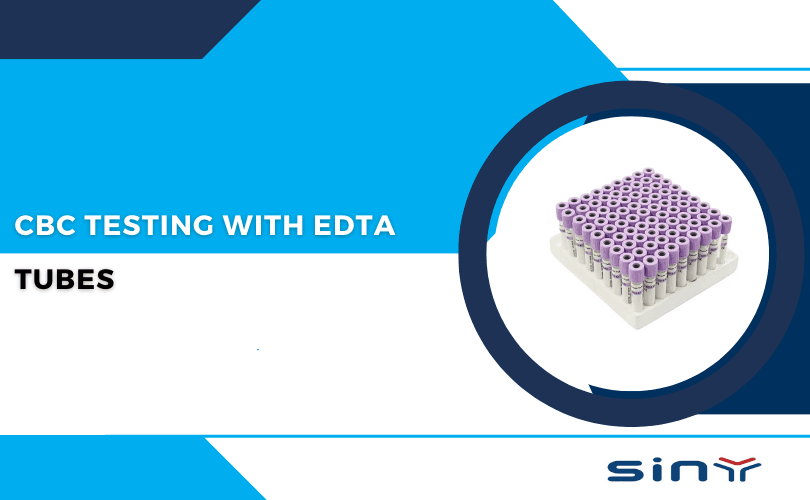
CBC Testing with EDTA Tubes: Complete Blood Count (CBC) is one of the most commonly performed laboratory tests worldwide. It evaluates the cellular components of blood, providing vital information about a patient’s overall health, nutritional status, immune system, and hematologic conditions. The use of EDTA tubes in CBC testing has made sample collection reliable and accurate, preserving blood cells and preventing clotting.
EDTA tubes are preferred because they act as anticoagulants by chelating calcium ions, which are essential for coagulation. This ensures that the blood remains fluid for precise analysis. Nurses, phlebotomists, and laboratory professionals rely on EDTA tubes for consistent CBC test results.
For more on EDTA tubes used in CBC, visit:
EDTA Tube is Used for CBC
Introduction to CBC Testing
A Complete Blood Count (CBC) provides information on the following blood components:
Red Blood Cells (RBCs): Carry oxygen to tissues.
White Blood Cells (WBCs): Part of the immune system.
Platelets: Help in clotting.
Hemoglobin (Hb): Oxygen-carrying protein in RBCs.
Hematocrit (Hct): Proportion of blood volume occupied by RBCs.
CBC testing helps detect anemia, infections, clotting disorders, and hematologic malignancies. EDTA tubes ensure accurate measurements by preventing coagulation and maintaining cell morphology.
Learn more about how EDTA helps in CBC:EDTA Tubes Help in CBC Complete Blood Count Tests

What is a Complete Blood Count (CBC)?
A Complete Blood Count (CBC) is a comprehensive test that evaluates the cellular components of blood, including:
- Red Blood Cells (RBCs): Responsible for oxygen transport.
- White Blood Cells (WBCs): Part of the immune system.
- Hemoglobin (Hb): The oxygen-carrying protein in RBCs.
- Hematocrit (Hct): The proportion of blood volume occupied by RBCs.
- Platelets: Essential for blood clotting.
The CBC is a cornerstone of diagnostic medicine, used to detect conditions like anemia, infections, and blood disorders
EDTA Tubes and Their Role in CBC
EDTA, which stands for Ethylenediaminetetraacetic acid, is a chelating agent that binds calcium ions in the blood. This anticoagulant property ensures that blood remains fluid, allowing accurate measurement of cellular components.
Types of EDTA Tubes used in CBC:
| Tube Type | Anticoagulant | Common Use |
|---|---|---|
| K2 EDTA Tube | Spray-dried K2 EDTA | CBC tests, hematology analysis |
| K3 EDTA Tube | Liquid K3 EDTA | CBC, flow cytometry |
| Lavender-top Tube | K2/K3 EDTA | Standard CBC collection |
EDTA tubes maintain the integrity of blood cells for several hours post-collection, making them ideal for manual or automated CBC procedures.
Check out products:
EDTA K2 Blood Collection Tubes for CBC Test
Step-by-Step CBC Procedure Using EDTA Tubes
The CBC procedure involves several key steps, from blood collection to analysis. Below is a detailed guide:
1. Patient Preparation
- Verify patient identity and explain the procedure.
- Ensure the patient is seated comfortably and has fasted if required (though fasting is not always necessary for CBC).
2. Equipment Setup
- Gather the necessary supplies: EDTA tubes, needles, tourniquet, alcohol swabs, and gauze.
3. Venipuncture
- Apply the tourniquet to locate a suitable vein (e.g., median cubital vein).
- Clean the puncture site with an alcohol swab.
- Perform venipuncture using a sterile needle.
4. Blood Collection
- Fill the EDTA tube to the required volume (typically 2–5 mL).
- Gently invert the tube 8–10 times to mix the blood with the anticoagulant.
5. Post-Procedure Care
- Remove the tourniquet and needle.
- Apply pressure to the puncture site with gauze.
- Label the tube with the patient’s details and send it to the laboratory.
For a visual guide, refer to this external resource.
CBC Test Results: Interpretation
CBC results provide valuable information about a patient’s health. Below are the key components and their normal ranges:
| Component | Normal Range |
|---|---|
| Red Blood Cells (RBC) | 4.7–6.1 million/µL (men) |
| White Blood Cells (WBC) | 4,000–11,000/µL |
| Hemoglobin (Hb) | 13.8–17.2 g/dL (men) |
| Hematocrit (Hct) | 40.7–50.3% (men) |
| Platelets | 150,000–450,000/µL |
Abnormal results may indicate conditions like anemia, infection, or leukemia.
Manual Complete Blood Count Procedure
Manual CBC procedures are less common today but still essential in resource-limited settings or specific diagnostic contexts. The steps include:
Preparation of a blood smear on a glass slide.
Staining using Wright’s or Giemsa stain.
Microscopic examination to identify abnormal cells.
Counting cells using a hemocytometer.
Manual procedures require precise technique and are often cross-checked with automated results to ensure accuracy.
Automated CBC Machine Procedure
Automated hematology analyzers allow rapid and precise analysis of multiple blood parameters:
Sample loading: The EDTA tube is placed in the machine.
Dilution and mixing: Blood is diluted and prepared for counting.
Electrical impedance or flow cytometry: WBC, RBC, and platelet counts are measured.
Data output: Complete report with RBC indices, WBC differential, and platelet counts.
Using EDTA tubes ensures minimal interference and consistent results in automated analyzers.
CBC Blood Test Fasting and Preparation
Fasting is generally not required for CBC, but hydration status can influence some parameters. Patients are encouraged to avoid vigorous exercise and stress, which can alter WBC counts.
For patients on anticoagulant therapy, laboratory staff may need to note medications as they can influence platelet function or morphology.
CBC Blood Test Abbreviations Explained
Understanding CBC results requires familiarity with common abbreviations:
RBC: Red Blood Cells
WBC: White Blood Cells
Hb: Hemoglobin
Hct: Hematocrit
MCV: Mean Corpuscular Volume
MCH: Mean Corpuscular Hemoglobin
MCHC: Mean Corpuscular Hemoglobin Concentration
PLT: Platelets
A clear understanding ensures proper interpretation of results for clinical decision-making.
For a visual guide:Complete Blood Count and Differential Image
Summary
The Complete Blood Count (CBC) is a vital diagnostic tool, and EDTA tubes play a central role in ensuring accurate results. By understanding the CBC procedure, interpreting results, and following best practices, healthcare professionals can deliver high-quality patient care.
For more information on EDTA tubes and related products, visit EDTA Tube Products or explore our EDTA Tube Category.
If you have further questions, feel free to Contact Us.
FAQs
Q1: Why are EDTA tubes used for CBC testing?
A: EDTA tubes prevent blood clotting, ensuring accurate analysis of blood components.
Q2: Does CBC testing require fasting?
A: Fasting is not usually required, but follow specific instructions from your healthcare provider.
Q3: What does a CBC test measure?
A: It measures red blood cells, white blood cells, hemoglobin, hematocrit, and platelets.
Q4: How long does a CBC test take?
A: Results are typically available within 24 hours.
Q5: Can EDTA tubes affect CBC results?
A: Yes, improper mixing or overfilling can lead to inaccurate results.