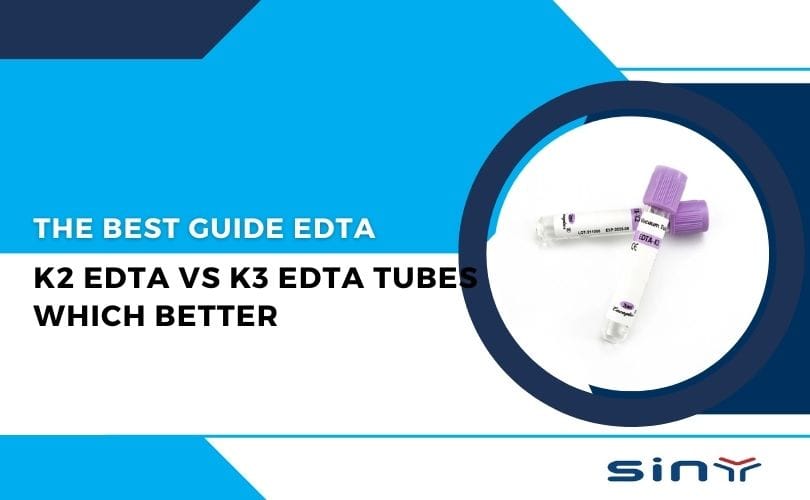
EDTA Blood Collection Tubes are a cornerstone of modern hematology, ensuring accurate test results by preventing blood clotting. Among these tubes, K2 EDTA and K3 EDTA are the most commonly used. But what sets them apart, and which one is better for your laboratory needs? This comprehensive guide explores the k2 edta and k3 edta difference, their uses, benefits, and why they are the anticoagulant of choice in routine haematology.
What Are EDTA Blood Collection Tubes?
EDTA Blood Collection Tubes are vacuum-sealed tubes containing ethylenediaminetetraacetic acid (EDTA), an anticoagulant that prevents blood clotting by binding calcium ions. These tubes are essential for hematology tests such as complete blood counts (CBC), blood typing, and other analyses requiring whole blood or plasma.
EDTA tubes are available in two main forms: K2 EDTA (dipotassium EDTA) and K3 EDTA (tripotassium EDTA). Both serve the same primary purpose but differ in their chemical composition and applications.
For more information on EDTA tubes, visit our product page.
Understanding K2 EDTA and K3 EDTA
K2 EDTA
K2 EDTA (dipotassium EDTA) is a liquid or spray-dried powder anticoagulant widely used in hematology. It is known for its stability and minimal impact on blood cell morphology, making it the preferred choice for routine tests.
K3 EDTA
K3 EDTA (tripotassium EDTA) is another form of EDTA anticoagulant, typically found in liquid form. While it serves the same purpose as K2 EDTA, it is less commonly used due to its potential effects on cell shrinkage.
For a detailed comparison, visit our guide on EDTA K2 vs K3 Differences, Uses, and Benefits.
K2 EDTA vs K3 EDTA: Key Differences
Understanding the k2edta vs edta distinctions is essential for selecting the right tube for specific tests. Here’s a breakdown of their differences:
Chemical Composition
- K2 EDTA: Contains dipotassium EDTA (two potassium ions).
- K3 EDTA: Contains tripotassium EDTA (three potassium ions).
Physical Form
- K2 EDTA: Available in liquid or spray-dried powder form.
- K3 EDTA: Typically found in liquid form.
Concentration
- K2 EDTA: Often has a higher concentration of EDTA.
- K3 EDTA: Generally has a lower concentration.
Impact on Blood Samples
- K2 EDTA: Causes less cell shrinkage and morphological changes.
- K3 EDTA: May lead to slight cell shrinkage due to higher osmolarity.
Usage in Hematology
- K2 EDTA: Preferred for routine hematology tests due to its stability.
- K3 EDTA: Used in specific applications but less commonly recommended.
For more details on K2 EDTA tubes, visit our product page.
K2 EDTA vs K3 EDTA Tubes: Detailed Comparison
Below is a detailed comparison table explaining the difference between K2 EDTA and K3 EDTA.
Comparison Table
| Feature | K2 EDTA Tube | K3 EDTA Tube |
|---|---|---|
| Chemical Form | Dipotassium EDTA | Tripotassium EDTA |
| State | Spray-dried/Powder | Liquid |
| Dilution | Very low | Higher |
| RBC Morphology | Natural shape preserved | RBC shrinkage possible |
| Platelets | Stable | Platelet swelling possible |
| CBC Accuracy | High | Slightly altered |
| ESR | Good | Good |
| Flow Cytometry | Recommended | Not recommended |
| Hematology Standard | Preferred worldwide | Less preferred |
| Tube Closure Color | Lavender | Lavender |
| Cost | Usually slightly higher | Slightly lower |
More comparison analysis is available from Siny Medical’s research page: EDTA K2 vs EDTA K3 Blood Tubes
Why K2 EDTA is the Anticoagulant of Choice
K2 EDTA is widely regarded as the anticoagulant of choice in routine haematology. Its popularity stems from its ability to preserve blood samples effectively while minimizing changes to cell structure. Here’s why it’s preferred:
- Stability: K2 EDTA maintains the integrity of blood cells, ensuring accurate test results.
- Minimal Cell Shrinkage: It causes less osmotic damage to red blood cells compared to K3 EDTA.
- Wide Acceptance: Many laboratories and healthcare institutions recommend K2 EDTA for standard hematology tests.
For more information on K2 EDTA tubes, check out our product category.
Why K2 EDTA Is Recommended for Routine Hematology
Global hematology guidelines recognize K2 EDTA as the standard anticoagulant for CBC because it maintains accurate values.
Here are the benefits explained in detail:
Minimal Dilution
Because K2 EDTA is spray-dried, it avoids introducing liquid volume into the blood. This ensures:
Accurate hematocrit
Accurate RBC indices
Proper MCHC measurement
Better Cell Preservation
K2 EDTA prevents cell distortion and keeps RBCs stable in their natural biconcave shape.
Trusted by Manufactures & Labs
The EDTA Tube Manufacturer page explains production-grade quality:
SINY Medical Supplies – EDTA K2 K3 Tube
Applications of K3 EDTA
While K3 EDTA is less commonly used than K2 EDTA, it still plays a role in specific medical applications. Here’s where K3 EDTA tube use comes into play:
- Alternative Option: Some laboratories use K3 EDTA when K2 EDTA is unavailable.
- Compatibility: It is compatible with automated analyzers and can be used for certain tests.
- Availability: K3 EDTA tubes are often more readily available in some regions.
For more details on K3 EDTA tubes, visit our product page.
Choosing Between K2 EDTA and K3 EDTA
The choice between K2 EDTA and K3 EDTA depends on the specific requirements of your laboratory and the tests being performed. Here’s a quick guide:
- For Routine Hematology: Opt for K2 EDTA due to its stability and minimal impact on blood cells.
- For Specific Applications: Consider K3 EDTA if it’s the only available option or if your tests are compatible with its properties.
For a detailed comparison, visit our guide on EDTA K2 vs K3 Differences, Uses, and Benefits.
In the world of blood collection, EDTA Blood Collection Tubes are indispensable. While both K2 EDTA and K3 EDTA serve as effective anticoagulants, K2 EDTA is the preferred choice for routine hematology due to its stability and minimal impact on blood cells. Understanding the k2 edta and k3 edta difference ensures accurate test results and optimal patient care.
For more information on EDTA tubes, explore our product range or contact us via our contact page.
By providing detailed insights into K2 EDTA and K3 EDTA, this guide aims to help healthcare professionals make informed decisions about blood collection tubes. For further reading, check out our external resources: Siny Medical’s Guide to EDTA Tubes and YouTube Channel.
When Is K3 EDTA Useful?
Although K3 EDTA is not ideal for CBC, it is still useful in specific cases:
ESR (Wintrobe / Westergren)
K3 EDTA can be used for ESR reading where slight dilution does not affect outcome.
Certain Chemistry/Research Applications
When cell morphology is not required, K3 EDTA serves well.
Budget-Oriented Laboratory Use
Some laboratories with high-volume testing choose K3 EDTA due to lower cost.
Effect of K2 and K3 EDTA on CBC Parameters
RBC Count
K2: Accurate
K3: Slightly reduced due to shrinkage
Hemoglobin
Both show stable values
MCV, MCH, MCHC
K2: Natural values
K3: MCV may appear lower due to altered RBC structure
Platelet Count
K2: Stable morphology
K3: Platelet swelling may lead to falsely high values
Why Most Labs Choose K2 EDTA
The official guide on EDTA Tube website highlights this preference:
EDTA K2 vs K3 Differences, Uses, and Benefits
According to laboratory standards worldwide:
K2 EDTA ensures accurate CBC
K3 EDTA causes noticeable variation
K2 tubes are used for flow cytometry research
Blood films from K2 EDTA show cleaner morphology
Summary
In the world of blood collection, EDTA Blood Collection Tubes are indispensable. While both K2 EDTA and K3 EDTA serve as effective anticoagulants, K2 EDTA is the preferred choice for routine hematology due to its stability and minimal impact on blood cells. Understanding the k2 edta and k3 edta difference ensures accurate test results and optimal patient care.
For more information on EDTA tubes, explore our product range or contact us via our contact page.
By providing detailed insights into K2 EDTA and K3 EDTA, this guide aims to help healthcare professionals make informed decisions about blood collection tubes. For further reading, check out our external resources: Siny Medical’s Guide to EDTA Tubes and YouTube Channel.
FAQs
What is the main difference between K2 EDTA and K3 EDTA tubes?
The primary difference lies in their chemical composition:
- K2 EDTA contains dipotassium EDTA (two potassium ions).
- K3 EDTA contains tripotassium EDTA (three potassium ions).
K2 EDTA is preferred for routine hematology due to its stability and minimal impact on blood cell structure, while K3 EDTA may cause slight cell shrinkage.
Why is K2 EDTA the anticoagulant of choice in hematology?
K2 EDTA is widely recommended because:
- It preserves blood cell morphology better than K3 EDTA.
- It causes less osmotic damage to red blood cells.
- It is the standard for automated hematology analyzers and ensures accurate CBC results.
Which EDTA tube is better for complete blood count (CBC) tests?
K2 EDTA is the gold standard for CBCs because:
- It minimizes pre-analytical errors (e.g., cell shrinkage).
- It is endorsed by organizations like CLSI and WHO for hematology testing.
Are K2 and K3 EDTA tubes interchangeable in blood banking?
No. For blood typing and crossmatching, K2 EDTA is preferred because:
- It maintains antigen integrity better.
- K3 EDTA’s liquid form may dilute samples, affecting antibody detection.s.
Where can I buy reliable K2 or K3 EDTA tubes?
Trusted suppliers include:
How should EDTA tubes be stored?
- Store at room temperature (15–30°C).
- Avoid freezing or direct sunlight, which can degrade EDTA.
- Check expiration dates to ensure anticoagulant efficacy.