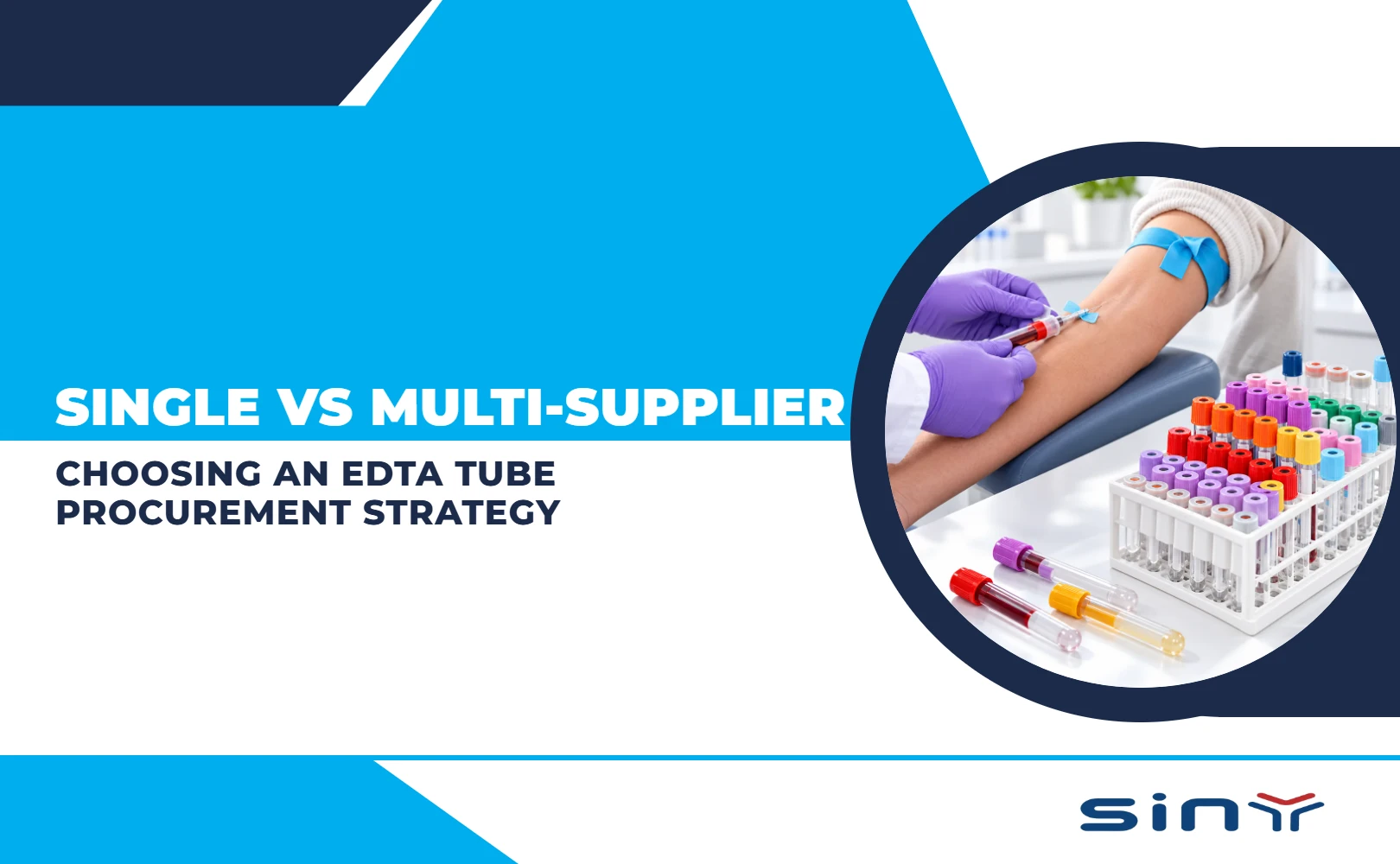
After a shortage or a late container, many buyers ask the same question: should we stop relying on one tube supplier? It sounds safer to spread orders. Yet in a lab, every tube change can shift results and cause handling problems. Choosing between single vs multiple EDTA tube suppliers is a balance between supply security and consistency.
This guide compares the options, explains the hidden costs of each, and shows how many hospitals and distributors combine them. It is written for procurement managers, lab directors and distributors. As an EDTA tube manufacturer, SINY serves as both main and backup supplier for different customers, so we see how each approach works in practice.
Short answer: A single supplier gives the most consistent tubes, simpler validation and better pricing, but leaves you exposed if that supplier fails. Multiple suppliers reduce supply risk but add validation work, more stock lines and possible result shifts. For EDTA tubes, most networks do best with one primary supplier for most volume and a validated backup supplier for a smaller share.
Key Takeaways
- Tube changes can shift CBC results slightly, so every supplier needs validation.
- Single sourcing simplifies quality control, training and stock, and often lowers price.
- Multiple sourcing protects against factory, shipping and regulatory disruptions.
- A primary-plus-backup model keeps consistency while managing risk.
- Keep the backup supplier active with regular small orders, not only in emergencies.
Why Supplier Strategy Matters for EDTA Tubes
EDTA tubes look like simple commodities, but small differences in vacuum, additive coating, tube size and label stock affect the lab. A new tube can change draw volume, analyser fit or even slightly shift some CBC values. At the same time, running out of tubes stops collection. Your supplier strategy must protect both result quality and supply continuity.
Single-Supplier Strategy
Advantages
- Consistency: the same tube in every site, so results and handling stay stable.
- Simple validation: one product set to test and approve.
- Better pricing: larger volume with one supplier often brings lower unit price.
- Easier training and stock: fewer models and part numbers.
- Stronger relationship: priority during busy periods and easier problem solving.
Risks
- Factory problems, raw material shortages or quality failures hit all your volume.
- Shipping delays or port closures leave no alternative.
- Regulatory changes can stop imports of one brand.
- Less leverage in price talks over time.
Multi-Supplier Strategy
Advantages
- Supply security: if one supplier fails, others continue.
- Price competition: suppliers know they can lose share.
- Geographic spread: suppliers in different regions reduce shipping risk.
Risks and hidden costs
- Each supplier needs samples, testing and approval.
- Different tubes may need different analyser settings or racks.
- More stock lines, more storage space and more expiry tracking.
- Staff may mix tube types, causing handling errors.
- Smaller volume per supplier can mean higher prices.
Comparison Table
| Factor | Single supplier | Multiple suppliers | Primary + backup |
|---|---|---|---|
| Result consistency | High | Lower | High for most samples |
| Supply risk | High | Low | Low to medium |
| Validation work | Low | High | Medium |
| Unit price | Often lowest | Varies | Good |
| Stock complexity | Low | High | Medium |
The Primary-Plus-Backup Model
Many hospital networks and distributors use a middle path:
- Choose one primary supplier for most volume, for example 70 to 90 percent.
- Validate a backup supplier for the same models, with paired CBC comparisons and fit tests.
- Place regular small orders with the backup so the relationship and documents stay current.
- Keep the backup’s tubes at selected sites or in central stock.
- Agree on emergency lead times with both suppliers.
This keeps most results on one tube type while giving you a tested fallback. For validation steps, see EDTA tube sample orders.
How to Choose Your Primary Supplier
- Quality system and product documents. See EDTA tube quality documentation.
- Capacity to handle your annual volume and growth.
- Track record on lead time and lot consistency.
- Willingness to sign a quality agreement. Read EDTA tube quality agreement.
- Responsiveness to complaints and questions.
Our EDTA tube supplier checklist gives 20 points to check.
Reducing Risk Without a Second Supplier
If a second supplier is not practical, you can still lower risk:
- Hold extra safety stock, sized to lead time. See EDTA tube demand forecasting.
- Share a rolling forecast so the supplier can plan production.
- Split shipments across several sailings or routes.
- Ask the supplier about their own raw material backup plans.
Common Mistakes
- Adding a second supplier without validating its tubes.
- Using the backup only in emergencies, then finding documents expired.
- Splitting volume so evenly that no supplier gives priority.
- Mixing tube types within one site without staff training.
Working with SINY
SINY works as a primary or backup EDTA tube supplier for distributors and lab networks, and can provide samples and documents for validation. Browse the EDTA tube range.
FAQ: Single vs Multiple EDTA Tube Suppliers
Is it better to use one or several EDTA tube suppliers?
For most labs, one primary supplier plus a validated backup works best. A single supplier gives consistency and better pricing; a backup protects against supply problems.
Can changing EDTA tube suppliers affect CBC results?
It can cause small shifts, because tubes differ in additive form, fill accuracy and dimensions. Validate any new tube with paired samples before using it.
How much volume should go to a backup supplier?
Many networks give the backup about 10 to 30 percent, or regular small orders, so documents and logistics stay active. Choose a share that fits your risk and validation capacity.
How do I reduce supply risk with a single supplier?
Hold safety stock based on lead time, share forecasts, split shipments and agree emergency lead times in your contract.
What should I check before adding a second supplier?
Check quality documents, run fit and draw volume tests, do a paired CBC comparison, confirm registration in your market and sign a quality agreement.
Summary
Choosing between single vs multiple EDTA tube suppliers is a trade-off between consistency and supply security. For most buyers, a primary supplier plus a validated, active backup gives the best balance. Validate every tube and keep documents current.
To evaluate SINY as a primary or backup supplier, contact our team.