Veterinary labs and clinics depend on veterinary EDTA tubes for almost every complete blood count. Yet many practices still use tubes designed for adult human patients. When a 1 mL sample from a kitten goes into a large tube, the results can suffer. The right tube size and handling make a real difference.
This guide explains how veterinary EDTA tubes are used, which sizes suit different animals, and what distributors and clinic buyers should check before ordering. It draws on published guidance from veterinary diagnostic laboratories. In addition, we show how SINY, an EDTA tube manufacturer, supplies small and standard tubes for veterinary distributors.
Why EDTA Tubes Are the Standard for Veterinary Haematology
EDTA binds calcium in the blood sample, so the blood does not clot. At the same time, it preserves cell shape well enough for counting and smear review. That is why veterinary labs use EDTA, the lavender or purple top tube, for routine haematology.
For example, the Cornell University Animal Health Diagnostic Center asks clinics to submit blood for haematology in EDTA tubes. Its guidance also covers tube filling, mixing, smears and shipping, which we summarise below.
Veterinary practice adds challenges that human labs see less often. Patients range from small birds to horses. Blood volumes vary widely. Moreover, samples often travel from the clinic to an outside lab. As a result, tube choice and handling matter even more.
Fill Volume: The Most Common Problem with Veterinary EDTA Tubes
EDTA tubes contain a fixed amount of anticoagulant for a stated blood volume. If the tube receives much less blood, the EDTA becomes too concentrated. Because EDTA is hypertonic, red cells can shrink.
The eClinpath sample collection guide from Cornell describes this directly. It warns that placing a small sample, such as 0.5 to 1 mL, into a standard 5 mL EDTA tube can shrink red cells. This changes measurements such as MCV and MCHC, and can cause cell shape changes on smears.
The fix is simple: match the tube to the sample. For small volumes, the guide prefers a microtainer tube with EDTA. Similarly, Cornell asks for EDTA tubes to be more than half full, and for microtainer tubes to be full.
Choosing veterinary EDTA tubes by animal size
Small animals and sick patients often give small samples. Therefore, clinics treating cats, small dogs, exotics and young animals need micro or low-volume tubes. Larger dogs may suit 2 mL to 3 mL tubes. Meanwhile, large animal practices often use standard 3 mL to 5 mL tubes, depending on the lab’s needs.
| Patient group | Typical sample size | Suggested tube type | Key point |
|---|---|---|---|
| Cats, small dogs, puppies, kittens | Small | Micro or 0.5 to 1 mL EDTA tube | Fill the tube fully |
| Medium and large dogs | Moderate | 1 to 3 mL EDTA tube | Fill more than half |
| Horses, cattle, other large animals | Larger | 3 to 5 mL EDTA tube | Fill to the marked line |
| Birds, reptiles, small exotics | Very small | Micro tube; follow lab advice | Ask the lab about anticoagulant |
These are general pairings, not rules. Always follow the receiving lab’s instructions, because some labs set their own minimum volumes.
Mixing and Handling Veterinary EDTA Tubes
After collection, the blood must mix with the EDTA quickly. Cornell recommends rolling the tube between the palms or inverting it gently several times. It also warns: do not shake the tube.
Shaking can damage cells and affect results. Therefore, train every team member to mix the same way. A short demonstration during onboarding prevents most errors.
For clinics with high caseloads, a simple wall card showing tube sizes, fill lines and mixing steps helps new staff follow the same routine every time.
Labelling matters too. Write the patient name, species, date and time on every tube. When samples travel to an outside lab, clear labels prevent mix-ups between patients from the same clinic.
Storage, Smears and Shipping
Many clinics send blood to a reference lab. That means the sample may spend hours or days in transit. According to Cornell, EDTA blood should stay refrigerated before submission and travel on a cold pack, without direct contact with the pack. Paper towels between the tube and the ice help prevent freezing.
Blood smears need different handling. Cornell suggests making two or three unfixed, unstained smears at collection time if there will be a delay. However, smears should not be refrigerated, because cold can damage cells on the slide.
For distributors, these points shape the product range. Clinics that ship samples need reliable tubes, good caps and clear labels. Our guide on how long blood can be stored in EDTA tubes explains storage time in more detail.
Technical Details for Veterinary EDTA Tubes
Veterinary EDTA tubes share most features with human tubes. Most use PET plastic, which is light and resists breakage. Caps are lavender or purple. Additives are usually K2 EDTA or K3 EDTA.
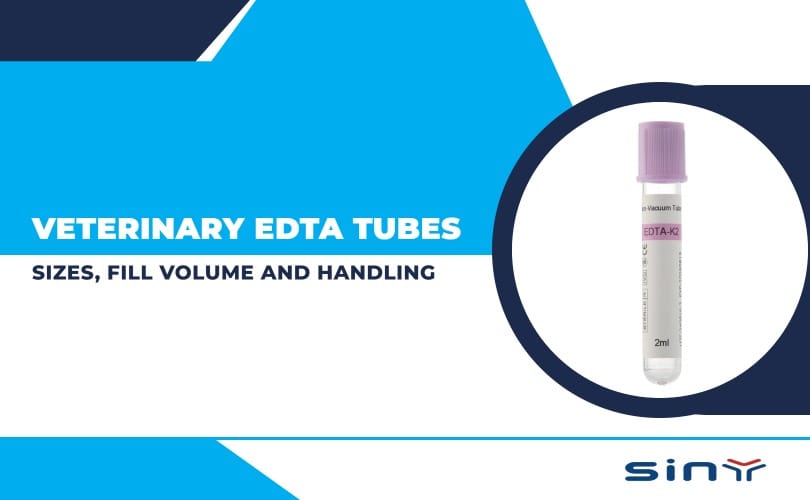
Vacuum tubes suit standard venipuncture with needles and holders. Non-vacuum tubes suit syringe or drip collection, which many small animal practices use. For example, SINY offers 2 mL non-vacuum EDTA K2 tubes for low-volume collection.
Tube size also affects handling in the lab. Small tubes may need adaptors in analyser racks. Therefore, ask your reference lab which sizes it accepts before you order large quantities.
K2 or K3 EDTA for veterinary use?
Both additives prevent clotting. K2 EDTA is usually spray-dried on the tube wall, while K3 EDTA is usually a liquid that slightly dilutes the sample. Many human haematology labs prefer K2 for cell counts. For veterinary work, ask your reference lab which version it validates on its analysers, then stock that version.
If you supply several labs, you may need both. SINY makes K2 EDTA blood collection tubes and K3 versions, so distributors can source both additives from one factory. In practice, this keeps documents and quality records consistent across your veterinary EDTA tubes.
Whichever additive you choose, keep it consistent within each clinic. Switching between K2 and K3 without telling the lab can make trend comparisons harder for the same patient over time.
Buying Guide for Veterinary Distributors and Clinics
Veterinary demand differs from hospital demand. Clinic order smaller quantities, more often, and they need a mix of sizes. As a result, distributors should keep several low-volume sizes in stock rather than one large size.
Price depends on size, material, additive, vacuum design and packaging. Smaller pack sizes cost more per tube to pack, but they suit clinics better. Private label packaging helps distributors build their own veterinary brand.
Questions to ask a supplier of veterinary EDTA tubes
- Which micro and low-volume EDTA tubes do you make?
- Do you offer both vacuum and non-vacuum versions?
- What is the MOQ per size, and can sizes be mixed?
- Can you supply smaller boxes suitable for clinics?
- Can labels show a veterinary brand and language?
- Which certificates and test reports cover these tubes?
Veterinary EDTA Tubes for Different Practice Types
Small animal clinics see the widest range of patient sizes in one day. Therefore, they need micro tubes for cats and toy breeds, plus 1 mL to 3 mL tubes for larger dogs. Many also prefer non-vacuum tubes, because syringe collection gives more control with small veins.
Mixed practices face a different challenge. In the morning, a vet may sample a cat; in the afternoon, a herd of cattle. As a result, they need both small and standard sizes, packed so that farm kits stay compact. Sturdy caps also matter, because tubes may travel in a vehicle for hours.
Equine and large animal practices usually draw larger volumes. However, they still need careful mixing and labelling, since samples often wait in a vehicle before reaching the lab. Meanwhile, exotic and avian practices work with very small samples and should follow their reference lab’s specific advice.
Shelter and charity clinics often run high volumes on tight budgets. For them, a simple, reliable range of two or three sizes keeps stock manageable. In addition, clear labels reduce errors when many staff and volunteers handle samples.
Stocking Plan for Veterinary Distributors
Veterinary distributors should start with demand data. Look at which clinic types you serve and how many CBCs they run each month. Then map each clinic type to the tube sizes above.
Next, keep pack sizes small enough for clinics. A clinic may not use a large hospital carton before the tubes expire. Consequently, smaller inner boxes reduce waste and make your offer more attractive.
Finally, watch expiry dates closely. Slow-moving micro tubes can expire on the shelf if you overstock them. A first-expiry, first-out rule in your warehouse protects margins. You can also see how tubes are made and packed on the SINY Medical YouTube channel, which helps your sales team explain the product to clinics.
Common Mistakes Clinics Make with Veterinary EDTA Tubes
The most common mistake is using one tube size for every patient. A standard tube may work for a large dog but cause errors for a kitten. Keep at least two sizes at every collection point.
Another mistake is delayed mixing. In a busy clinic, a tube may sit on the bench while staff restrain the patient. Instead, mix the tube right after filling, then label it.
Finally, clinics sometimes refrigerate smears with the blood tube. Because cold damages cells on slides, keep smears at room temperature and blood tubes cool, as the lab guidance advises.
Why Work with SINY
SINY manufactures EDTA tubes in a 12,000 square metre factory with a capacity of up to 500,000 tubes per day. The range covers vacuum and non-vacuum tubes from 2 mL to 10 mL, in PET and glass. SINY offers OEM manufacturing and custom design, and lists CE and ISO 13485 certification for its EDTA tubes.
Veterinary distributors can also choose sterile 2 mL vacuum EDTA K2 tubes for standard venipuncture.
To compare every option, browse the SINY EDTA tube range.
FAQ: Veterinary EDTA Tubes
Which tube is used for a CBC in animals?
Veterinary labs use an EDTA tube, usually with a lavender or purple cap, for a complete blood count. EDTA prevents clotting and preserves cells for counting and smear review. When ordering veterinary EDTA tubes, choose sizes that match your patients, because small samples in large tubes can distort results. Always follow your reference laboratory instructions.
What happens if an EDTA tube is underfilled?
An underfilled tube has too much EDTA for the blood volume. Because EDTA is hypertonic, red cells can shrink, which changes measurements such as MCV and MCHC. Veterinary guidance therefore recommends small microtainer tubes for small samples. Choosing the right veterinary EDTA tubes for each patient size helps avoid this common error.
Should veterinary EDTA tubes be refrigerated?
Lab guidance from Cornell advises keeping EDTA blood refrigerated before submission and shipping it on a cold pack, without direct contact with the pack. Blood smears, however, should not be refrigerated. Follow your laboratory instructions for storage. Good handling protects samples collected in veterinary EDTA tubes during transport to an outside lab.
Can I use human EDTA tubes for animals?
Many veterinary practices use the same EDTA tubes that human labs use, because the additive and design are similar. The important point is size. Small animals and exotics often need micro or low-volume tubes. When buying veterinary EDTA tubes, ask your supplier for small formats and confirm they fit your analyser or reference lab.
Do you supply veterinary EDTA tubes in bulk?
Yes. SINY manufactures EDTA tubes in several sizes, including non-vacuum and low-volume formats suitable for veterinary distributors. We offer mixed-size orders, private label packaging and export shipping. Contact the team with your size list and expected volumes, and we will recommend veterinary EDTA tubes that match your clinic customers.
Summary
Veterinary EDTA tubes are the standard choice for animal haematology. The key is matching the tube size to the sample, mixing gently, and handling samples and smears correctly during storage and shipping. Small and sick patients need small tubes, filled properly.
For distributors, success means a flexible range of sizes, clinic-friendly packs and clear labels. To discuss veterinary EDTA tubes, private label options or mixed-size orders, contact the SINY team.