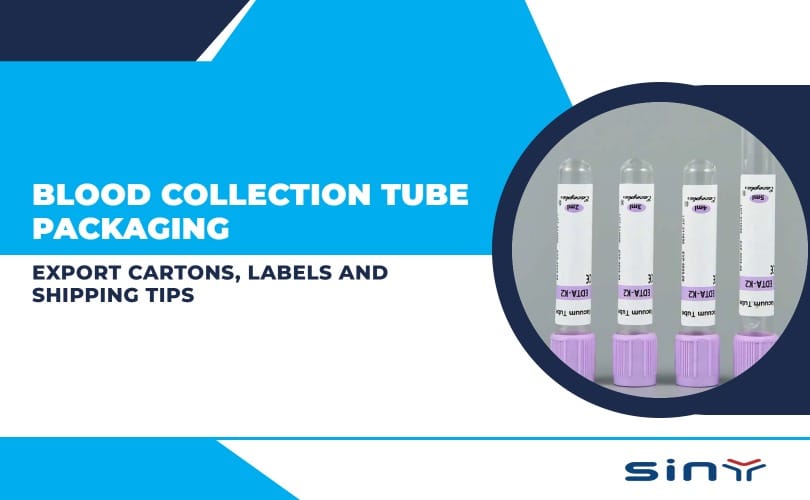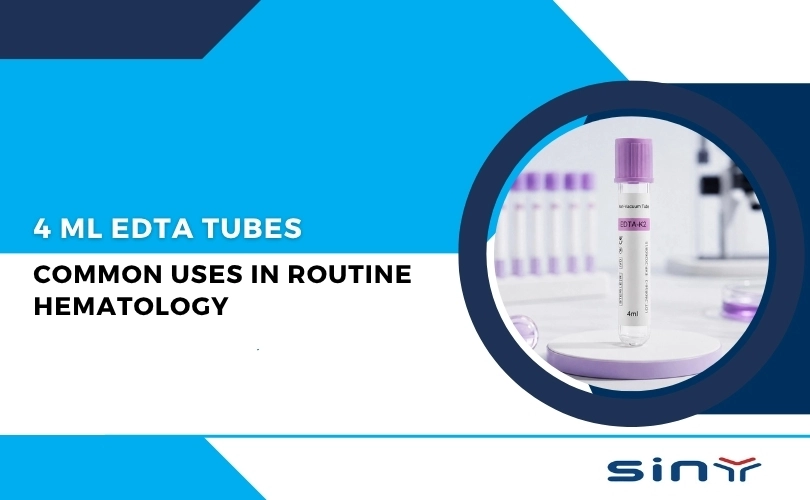
Choosing the correct blood collection tube can look simple, but small details affect laboratory workflow. Tube size, anticoagulant type, fill volume, mixing, storage, and analyzer requirements all matter. For many routine hematology procedures, 4 mL EDTA Tubes provide a useful balance between adequate sample volume and practical blood collection.
EDTA tubes are widely associated with complete blood counts, white blood cell analysis, platelet measurements, and other whole-blood hematology procedures. EDTA prevents clot formation by binding calcium ions needed for coagulation. The U.S. FDA describes K2EDTA blood collection tubes as devices whose EDTA coating binds calcium and blocks the coagulation cascade.
A 4 mL format can also leave enough specimen for repeat analysis, instrument flags, or a blood smear without automatically requiring a much larger draw. The CDC has used 3- or 4-mL K2EDTA tubes for CBC collection in its NHANES laboratory procedures, showing that this volume range has a clear place in established hematology workflows.
Laboratories comparing collection options can explore the EDTA Tube product range or review the dedicated EDTA blood collection tube category.
What Are 4 mL EDTA Tubes?
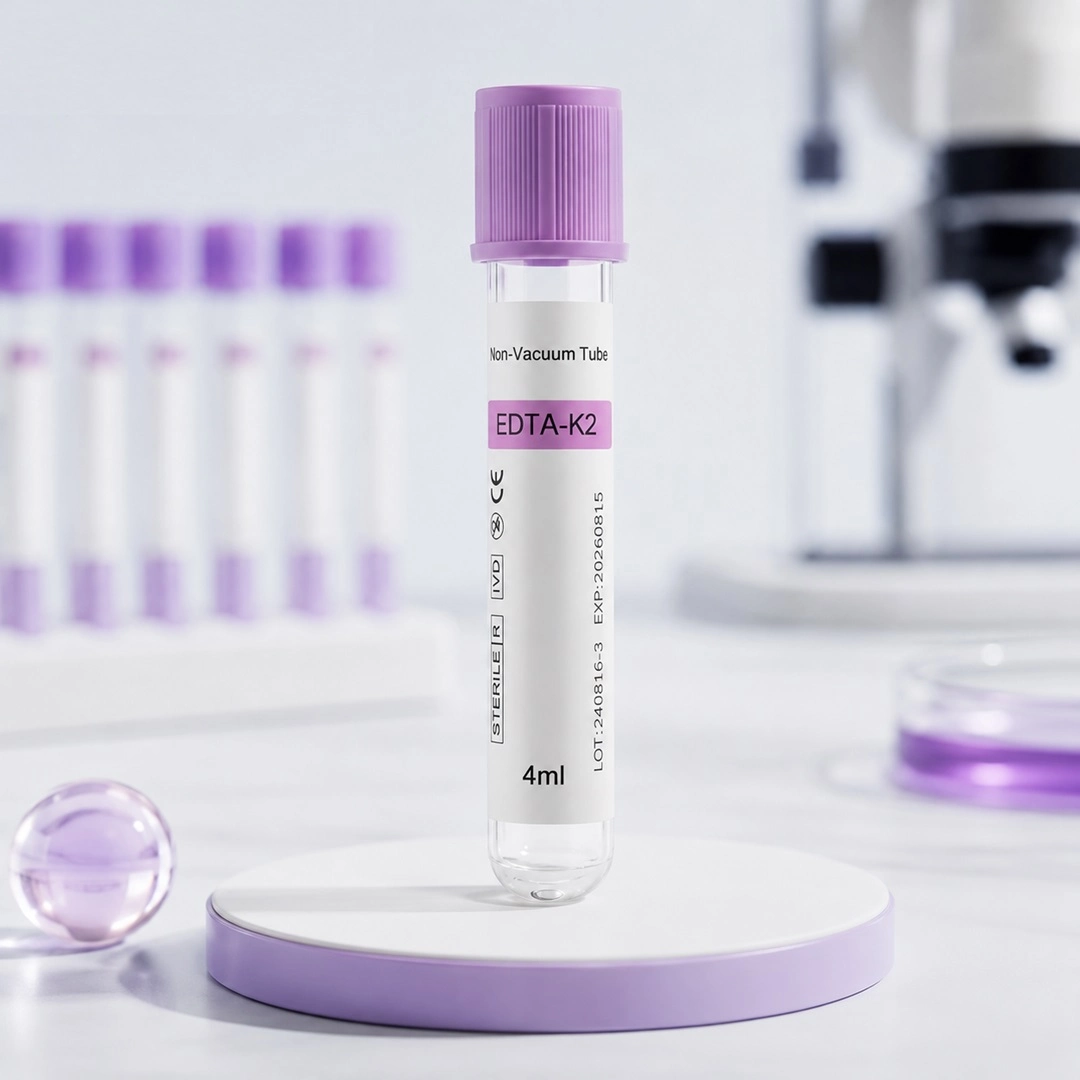
4 mL EDTA Tubes are blood collection containers designed to collect approximately four milliliters of whole blood while exposing the specimen to a measured EDTA anticoagulant.
The additive may be K2EDTA or K3EDTA, depending on the tube design and manufacturer. However, K2EDTA has become particularly important in modern hematology.
The International Council for Standardization in Haematology recommended dipotassium EDTA as the anticoagulant of choice for blood-cell counting and sizing. Its recommendation described an EDTA concentration of approximately 1.5–2.2 mg per milliliter of blood.
A scientific review has likewise noted that EDTA is widely preferred for hematological testing because it provides strong preservation of cellular blood components.
For laboratories evaluating K2EDTA specifically, the K2 EDTA blood collection tube page provides product information.
The lavender or purple closure commonly associated with these tubes also helps identify the anticoagulant category. Readers who want more background can review why EDTA tubes are purple and the guide to the purple-cap EDTA anticoagulant tube system.
Why 4 mL EDTA Tubes Work Well for Routine Hematology
Routine hematology usually requires enough whole blood for the initial test plus some reserve specimen.
A very small tube may provide sufficient blood for one analyzer run. However, it may leave less material when the instrument generates a flag, the technologist needs a repeat measurement, or a manual smear becomes necessary.
That is where 4 mL EDTA Tubes become useful.
Four milliliters can provide a practical working volume without moving into a large-volume collection unnecessarily. The CDC’s NHANES CBC procedure has explicitly specified collection in a 3- or 4-mL K2EDTA tube for participants aged one year and older.
The EDTA Tube size guidance can help laboratories understand how lower-volume tubes compare, while the 3 mL EDTA tube guide provides more detail on smaller routine collections.
Importantly, a 4 mL tube is not automatically the correct choice for every CBC. Analyzer dead volume, aspiration requirements, repeat-testing policies, and local validation still determine the minimum acceptable specimen.
4 mL EDTA Tubes for Complete Blood Count Testing
One of the most common applications for 4 mL EDTA Tubes is the complete blood count, commonly called the CBC.
A CBC measures major cellular components of blood. Depending on the analyzer and reporting profile, it may include red blood cell count, white blood cell count, platelet count, hemoglobin, hematocrit, red cell indices, and a white-cell differential.
FDA documentation for EDTA blood collection systems identifies K2EDTA and K3EDTA tubes for hematology testing involving white blood cells, red blood cells, and related cellular measurements.
The CDC also uses EDTA specimens in standardized CBC workflows, including 3- and 4-mL collection tubes.
As a result, 4 mL EDTA Tubes fit naturally into many general hematology departments, outpatient laboratories, hospital laboratories, and diagnostic centers.
White Blood Cell Counts and Differentials
White blood cell analysis requires anticoagulated whole blood because the laboratory needs to examine cellular components rather than serum alone.
4 mL EDTA Tubes can support both the total WBC count and automated differential when the laboratory’s instrument accepts that specimen type and volume.
A differential may report major leukocyte groups such as neutrophils, lymphocytes, monocytes, eosinophils, and basophils. Modern analyzers may also produce additional flags or immature-cell information.
If an unusual result appears, technologists may need to review the sample or prepare a blood film. Having some reserve blood can therefore be useful.
Red Blood Cell Measurements
Routine CBC testing also measures red blood cells and related indices.
These can include RBC count, hemoglobin, hematocrit, mean corpuscular volume, mean corpuscular hemoglobin, and other parameters.
Because EDTA prevents clotting while helping maintain blood cells for analysis, 4 mL EDTA Tubes are well suited to these hematology measurements when they match the laboratory’s validated procedure. The established role of K2EDTA in blood-cell counting is supported by international hematology recommendations.
Platelet Counts
Platelet counting is another major application.
A properly collected specimen in 4 mL EDTA Tubes can support routine automated platelet measurement. Nevertheless, laboratories must recognize EDTA-dependent platelet clumping.
In some people, platelets aggregate in vitro when blood contacts EDTA. This can cause an automated analyzer to report a falsely low platelet count. Research has documented K2EDTA-related platelet clumping and the need for alternative approaches in affected specimens.
Therefore, unexpected thrombocytopenia combined with platelet-clump flags may require smear review or recollection according to the laboratory’s validated procedure.
Peripheral Blood Smears and 4 mL EDTA Tubes
Automated analyzers handle a large share of routine hematology. However, microscopic blood-film examination still has an important role.
A peripheral smear can help evaluate cell morphology, investigate analyzer flags, assess abnormal white cells, and confirm suspected platelet clumping.
4 mL EDTA Tubes can be useful because the same collection may provide enough specimen for the initial CBC and subsequent smear preparation.
However, timing matters.
Cell morphology can change during prolonged storage. Laboratories should therefore follow their validated time limits for preparing and reviewing films.
The CDC also recognizes EDTA-anticoagulated venous blood for certain blood-smear procedures.
This does not mean every smear procedure requires a 4 mL specimen. Rather, the 4 mL format can give routine laboratories additional working volume when microscopy follows automated testing.
Reticulocyte Testing
Reticulocytes are immature red blood cells. Their measurement helps assess bone marrow response and red blood cell production.
Some hematology analyzers perform reticulocyte testing from EDTA-anticoagulated whole blood.
A study evaluating underfilled K2EDTA tubes examined CBC, white-cell differential, and reticulocyte results. It found acceptable performance for many parameters at certain reduced volumes under the specific experimental conditions.
Consequently, 4 mL EDTA Tubes can provide enough specimen for CBC plus analyzer-dependent reticulocyte testing when both procedures are validated for the same collection.
Laboratories should still check reagent requirements and analyzer instructions before combining tests.
Comparing 2 mL, 3 mL, 4 mL, and 5 mL EDTA Tubes
There is no universally perfect EDTA tube size.
The best volume depends on the patient, analyzer, test panel, potential repeats, and additional procedures.
| Tube Volume | Typical Practical Fit | Main Advantage | Main Limitation |
|---|---|---|---|
| 2 mL | Low-volume or selected pediatric collections | Minimizes blood draw | Less reserve specimen |
| 3 mL | Compact routine hematology | Good balance for basic testing | Limited reserve for extensive add-ons |
| 4 mL | Routine adult hematology and CBC workflows | Useful testing and repeat volume | More blood than very small workflows need |
| 5 mL | Broader panels or additional procedures | More reserve specimen | May be unnecessary for simple CBC testing |
This table represents practical workflow considerations rather than universal specimen rules.
CLSI recommends considering low-volume tubes for pediatric phlebotomy because they can reduce both blood volume and vacuum pressure on fragile veins.
Therefore, 4 mL EDTA Tubes may be a sensible choice for many adult routine collections, while smaller tubes may be preferable for children or other low-volume situations.
For additional comparison, readers can review the 2 mL versus 3 mL EDTA tube guide before deciding how much blood their workflow actually requires.
Why Correct Fill Volume Matters in 4 mL EDTA Tubes
Tube capacity and actual fill volume are not the same thing.
The amount of EDTA inside the tube is intended to work with a defined volume of blood. Significant underfilling increases the EDTA-to-blood ratio.
That can change some hematology results.
The International Council for Standardization in Haematology recommended roughly 1.5–2.2 mg of dipotassium EDTA per milliliter of blood for cell counting and sizing.
Research into underfilled K2EDTA tubes found that many CBC parameters remained acceptable under certain study conditions. However, platelet results showed progressively greater bias as collection volume decreased.
Therefore, laboratories should not intentionally underfill 4 mL EDTA Tubes simply because an analyzer can aspirate a smaller amount.
The better approach is to follow the manufacturer’s target fill and establish a validated minimum volume for the specific tube and analyzer combination.
K2EDTA vs K3EDTA in 4 mL EDTA Tubes
Laboratory staff often see both K2EDTA and K3EDTA mentioned in blood collection products.
Both forms chelate calcium and prevent clotting. However, they are not identical.
K2EDTA has long received preference in international hematology standardization for blood-cell counting and sizing.
K2EDTA is commonly applied as a dry or spray-dried coating. FDA documentation for one major K2EDTA system describes a spray-coated tube wall, with the additive binding calcium ions to block coagulation.
Comparative research between K2EDTA and K3EDTA has found only small differences for many routine parameters in some settings, while also identifying additive-related effects under particular conditions.
Thus, when purchasing 4 mL EDTA Tubes, laboratories should verify more than the volume. They should confirm the specific EDTA salt, tube material, manufacturer’s instructions, and analyzer compatibility.
The guide on K2 EDTA versus heparin tubes also explains why EDTA and heparin tubes should not be treated as interchangeable.
How EDTA Prevents Clotting
Understanding the chemistry makes tube selection easier.
Calcium ions participate in the coagulation cascade. EDTA acts as a chelating agent, meaning it binds metal ions such as calcium.
Once calcium becomes unavailable, normal clot formation cannot proceed effectively inside the collection tube.
FDA documentation describes this calcium-binding mechanism directly for K2EDTA blood collection tubes.
For readers interested in general chemistry, the overview of ethylenediaminetetraacetic acid explains EDTA’s metal-binding properties.
The EDTA Tube resource on purple-cap anticoagulant function also provides a product-focused explanation.
This mechanism is ideal for many hematology tests. However, EDTA is not a universal blood collection additive.
Coagulation studies, many chemistry tests, and serum-based assays may require completely different tubes.
Proper Collection and Mixing of 4 mL EDTA Tubes
Good analytical performance starts during phlebotomy.
Before collection, staff should verify patient identity, requested tests, tube type, additive, expiration date, and fill requirement.
After collecting blood into 4 mL EDTA Tubes, the specimen needs proper contact with the anticoagulant.
Gentle inversion distributes EDTA through the blood. The exact number of inversions should follow the specific manufacturer’s instructions.
Aggressive shaking is not a substitute for correct mixing.
Incorrect handling may affect specimen quality and can contribute to analytical problems.
The tube should also remain properly identified from collection through analysis. Patient details and specimen labels must follow local laboratory and healthcare policies.
Where 4 mL EDTA Tubes Fit in the Order of Draw
When a phlebotomist collects several tubes during one venipuncture, sequence matters.
CLSI explains that the order of draw reduces additive carryover between collection tubes. Its standard sequence places EDTA tubes after heparin tubes and before sodium fluoride/potassium oxalate tubes.
Therefore, 4 mL EDTA Tubes should not simply be drawn whenever convenient during a multi-tube collection.
For the standard order described by CLSI, the sequence is blood culture, citrate, serum, heparin, EDTA, and then glycolytic-inhibitor tubes.
Laboratories should incorporate the applicable collection sequence into staff training and written procedures.
Storage and Sample Stability
Collecting a good specimen is only the first stage. Laboratories must also control the time between collection and testing.
Cell characteristics can change during storage. Consequently, laboratories should follow analyzer-specific and test-specific stability requirements.
The CDC’s NHANES CBC laboratory procedure states that when a CBC cannot be analyzed within two hours, its 3- or 4-mL EDTA specimen is stored at room temperature for no more than 24 hours under that specific validated protocol.
That CDC procedure should not be converted into a universal storage rule.
Different analyzers, parameters, laboratories, and downstream tests can have different stability limits.
For 4 mL EDTA Tubes, the safest approach is to establish handling and storage limits from the assay instructions and local validation.
4 mL EDTA Tubes in Immunohematology
EDTA blood is not limited to automated CBC testing.
Certain EDTA collection systems also have applications in immunohematology.
FDA documentation states that approved K2EDTA blood collection tubes may be used for procedures such as ABO blood grouping and Rh typing. At the same time, the FDA documentation emphasizes that users must validate performance for their specific assay, instrument, reagent system, and storage conditions.
Therefore, 4 mL EDTA Tubes may fit some blood-bank or immunohematology workflows, but the receiving laboratory’s requirements always take priority.
A tube that works for a CBC should not automatically be assumed suitable for every transfusion-related test.
When a 4 mL Tube May Be Too Large or Too Small
A routine adult CBC may fit comfortably within the capacity of 4 mL EDTA Tubes. However, different clinical situations require different decisions.
For a child or a patient requiring strict blood conservation, 4 mL may exceed what the test actually needs. CLSI specifically supports low-volume collection systems in pediatric phlebotomy when appropriate.
At the opposite end, 4 mL may not provide enough specimen when several additional procedures are expected.
Examples include repeat analyzer runs, extensive manual testing, multiple send-out procedures, research aliquots, or assay-specific molecular testing.
The decision should therefore follow a simple principle:
Collect enough blood for the complete validated testing plan, but avoid unnecessary collection.
Choosing Reliable 4 mL EDTA Tubes
A laboratory purchasing decision should consider more than price.
First, verify whether the tube contains K2EDTA or K3EDTA. Next, check the nominal draw volume, additive concentration, tube material, dimensions, closure system, sterility status where applicable, lot identification, shelf life, and labeling.
The tube must also fit existing racks, centrifugation procedures where relevant, transportation systems, and laboratory analyzers.
For product comparison, laboratories can review 1–10 mL K2 EDTA vacuum blood collection options and EDTA tubes for blood collection.
The broader EDTA Tube homepage also provides access to product categories and technical information.
Manufacturer information is available through the SINY Medical EDTA tube page. Commercial buyers can also review the SINY Medical supplier profile and the company’s YouTube product channel.
However, purchasing claims should not replace laboratory validation, analyzer instructions, or applicable regulatory requirements.
Common Mistakes to Avoid With 4 mL EDTA Tubes
The first mistake is choosing the tube only by color.
Lavender and purple closures commonly indicate EDTA, but staff should confirm the actual additive printed on the label.
The second mistake is ignoring fill volume.
Significant underfilling changes the ratio between blood and anticoagulant. Research shows that some parameters tolerate lower K2EDTA volumes better than others. Platelet measurements can be particularly sensitive under certain underfilled conditions.
Another mistake is poor mixing. Blood must contact the additive adequately after collection.
Finally, laboratories should avoid assuming that 4 mL EDTA Tubes support every assay that uses whole blood.
Each procedure can have its own additive, volume, transport, temperature, and stability requirements.
For additional background, review the guide to EDTA blood anticoagulant in collection tubes.
Frequently Asked Questions
Are 4 mL EDTA tubes suitable for CBC testing?
Yes. 4 mL EDTA Tubes are well suited to many CBC workflows when the hematology analyzer accepts that specimen volume. The CDC has used 3- or 4-mL K2EDTA specimens in standardized CBC procedures, although each laboratory should follow its own validated requirements.
What tests can be performed using a 4 mL EDTA specimen?
4 mL EDTA Tubes may support CBCs, white-cell differentials, platelet counts, red-cell measurements, reticulocyte testing, and selected immunohematology procedures. The exact test menu depends on the analyzer, assay instructions, additive, specimen stability, and laboratory validation.
Are 4 mL EDTA tubes better than 3 mL tubes?
Neither size is automatically better. 4 mL EDTA Tubes provide more reserve specimen, which can help with repeat testing or additional procedures. A 3 mL tube may be preferable when the laboratory requires less blood and wants to minimize collection volume.
Can 4 mL EDTA tubes be underfilled?
Laboratories should normally fill 4 mL EDTA Tubes according to their intended draw volume. Research shows that some underfilled K2EDTA specimens can produce acceptable results, but the effect varies by parameter and testing system.
Are 4 mL EDTA tubes used for blood grouping?
Some 4 mL EDTA Tubes may support immunohematology procedures when the product and receiving laboratory permit their use. FDA documentation recognizes K2EDTA collection tubes for procedures such as ABO grouping and Rh typing, while also requiring validation for specific test systems.
What is the difference between 4 mL EDTA tubes and heparin tubes?
4 mL EDTA Tubes use EDTA to bind calcium and are strongly associated with hematology. Heparin tubes use a different anticoagulant mechanism and commonly serve different laboratory applications. The two tube types should never be considered interchangeable without method-specific instructions.
Summary
4 mL EDTA Tubes offer a practical specimen volume for many routine hematology workflows.
They can support CBC testing, blood cell counts, platelet analysis, differentials, reticulocyte procedures, blood-smear preparation, and selected validated immunohematology applications.
Their advantage comes from balance. Four milliliters can provide enough specimen for routine analysis and possible repeats without automatically requiring a much larger blood draw.
However, reliable results depend on more than tube capacity. Laboratories must also control the EDTA type, correct fill volume, specimen mixing, order of draw, storage conditions, analyzer compatibility, and testing time.
International hematology recommendations support K2EDTA for blood-cell counting, while FDA and CDC documentation confirm the established role of EDTA systems in hematology and standardized CBC workflows.
For laboratories comparing products, explore the EDTA blood collection tube catalog, browse the EDTA tube category, or contact EDTA Tube for product specifications.