EDTA coated tubes are a foundation of modern hematology and clinical diagnostics. Laboratories, hospitals, research centers, and medical device distributors depend on these tubes for accurate blood analysis, stable sample preservation, and reliable anticoagulation performance. To meet international expectations, manufacturers follow standardized procedures that control everything from raw material selection to final product packaging.
This detailed guide explores the Production Process of EDTA Coated Tubes, the Quality Assurance for EDTA Coated Tubes, global EDTA Tube Manufacturing Standards, and how manufacturers maintain accuracy in every step. This article is crafted for medical professionals, buyers, distributors, and anyone interested in understanding how high-quality EDTA Coated Blood Collection Tubes are made.
For more product details, you may visit the complete range atEDTA Tube Products.
What EDTA Coating Means and Why It Is Used in Blood Collection Tubes
EDTA (Ethylenediaminetetraacetic Acid) is a chelating compound widely used to prevent blood from clotting inside collection tubes. It works by binding calcium ions, which stops the coagulation process and preserves blood cell morphology.
A complete scientific definition of EDTA can be found here:Ethylenediaminetetraacetic Acid – Wikipedia
When applied inside a tube, EDTA ensures that:
Blood cells retain natural shape and size
Platelet counts remain stable
White and red blood cell structure remains undistorted
Laboratory analyzers receive accurate specimens
Because of these benefits, EDTA tubes are essential for:
Hematology analyzers
CBC tests
Blood morphology studies
Genetic and molecular diagnostics
You can explore more information on EDTA tubes here:Complete Guide to EDTA Tubes
Materials Used in EDTA Coated Tubes
The quality of an EDTA tube begins with the raw materials. Every component must meet medical-grade safety standards. Manufacturers disclose their materials in detail here:Materials Used in EDTA Tubes
The main materials include:
1. Medical-grade PET or Glass Tubes
PET (Polyethylene Terephthalate) is commonly used due to its durability, transparency, and compatibility with coating substances.
2. Precision-Formed Butyl Rubber Stopper
Ensures airtight sealing and compatibility with automated analyzers.
3. Plastic Cap or Color-Coded Closure
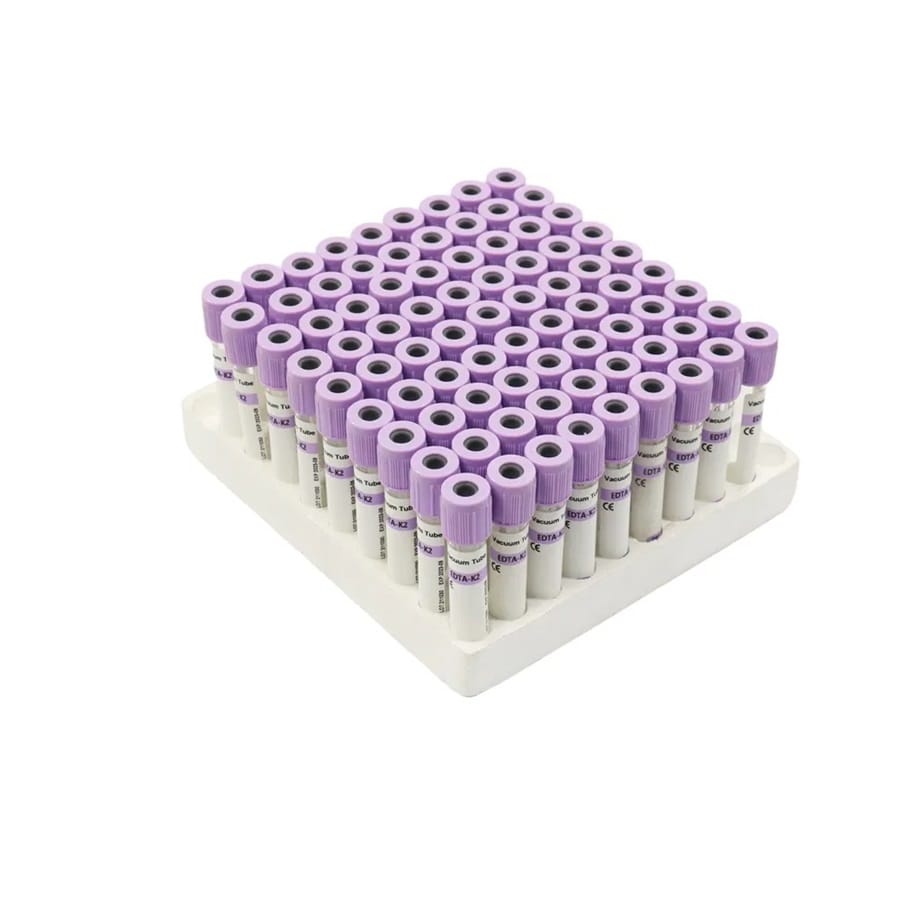
Lavender or purple caps indicate the presence of EDTA.
4. Spray-Dried Potassium EDTA (K₂EDTA or K₃EDTA)
The anticoagulant is applied through automated spraying equipment to ensure uniform distribution.
You can also review EDTA tube manufacturing details here:EDTA Tube by Siny Medical
Manufacturing Process of EDTA Coated Tubes
EDTA coated tube production follows a step-by-step process to maintain consistency, sterility, and accurate anticoagulant distribution. A detailed workflow can also be seen here:7 Steps of Blood Collection Tube Manufacturing
EDTA Tube manufacturing steps also appear on the official process page:How EDTA Tubes Are Manufactured
Below are the full stages involved in the EDTA Coated Tubes Manufacturing Steps:
Raw Material Inspection and Sorting
Quality begins at the material inspection stage. Every PET tube, rubber stopper, and plastic cap undergoes:
Dimensional testing
Visual defect examination
Contamination check
Chemical safety certification review
Manufacturers use high-resolution sensors to ensure consistency before moving to the next step.
Tube Molding and Forming
Tubes are shaped using injection molding or test-tube forming machines. At this stage:
Tube thickness is calibrated
Transparency is verified
External and internal smoothness is checked
PET tubes must withstand vacuum pressure, centrifugation, and transportation stress without cracking.
Cleaning and Surface Preparation
Before coating, tubes pass through a cleaning process using:
Ionized air
Medical-grade water
Contact-free drying
This ensures the internal surface is free of dust, moisture, and particles that could interfere with EDTA adhesion.
EDTA Spray Coating Application
This is the central step of the EDTA Coated Tubes Industry Standards. EDTA is sprayed precisely inside each tube. Automated machines ensure:
Accurate EDTA volume per tube
Uniform distribution across the inner surface
Powder-fine particle size for fast dissolution
There are two types of EDTA used:
| Type | Code | Usage |
|---|---|---|
| Tripotassium EDTA | K₃EDTA | Automated analyzers, improved solubility |
| Dipotassium EDTA | K₂EDTA | Routine hematology, stable morphology |
Correct EDTA dosage is essential because:
Too much EDTA may shrink red cells
Too little EDTA may allow clotting
This step is heavily monitored through inline sensors.
Precise Vacuum Setting
Blood collection tubes are designed to draw a fixed volume of blood automatically. Vacuum setting ensures:
Accurate blood-to-anticoagulant ratio
Reliable test results
Standardized sample volume
Calibration machines remove oxygen and insert controlled negative pressure inside each tube.
Stopper Assembly and Capping
Once the tube is coated and vacuum-sealed:
A sterile butyl rubber stopper is inserted
A color-coded cap is attached
Cap tightness is verified with pressure sensors
Purple caps represent EDTA coating and follow international color codes.
Labeling and Batch Coding
Manufacturers print:
Tube size
Additive type
Expiry date
Batch LOT number
Sterilization method
Labels must stay readable even after refrigeration or centrifugation.
Sterilization
Most EDTA tubes are sterilized using Gamma irradiation or Ethylene Oxide (EO). This eliminates microbial contamination while maintaining:
Additive stability
Tube clarity
Material integrity
Sterilization records are maintained for regulatory audits.
Final Inspection and Quality Checking
Every tube undergoes strict EDTA Tube Quality Control Measures, including:
Vacuum volume testing
Tube integrity checks
Stopper leakage testing
Anticoagulant uniformity verification
Hemolysis detection tests
Detailed descriptions of these tests are available through manufacturing examples on the Siny Medical channel:Siny Medical – YouTube
Additional product details and certifications may be found here:Siny Medical on Made-in-China
Packaging and Carton Sealing
EDTA tubes are packed into:
Vacuum-sealed sleeves
100-piece racks
Bulk carton boxes
Packages must protect tubes during long-distance transportation and temperature variation.
Industry Standards for EDTA Coated Tubes
Every manufacturer aims to meet global standards such as:
ISO 13485 Medical Device Standard
CE Certification
GMP (Good Manufacturing Practices)
WHO and CLSI Laboratory Guidelines
These standards ensure:
Safe materials
Valid manufacturing steps
Reliable anticoagulant performance
Stable tube shelf-life
These guidelines are followed across the entire line of EDTA products offered at:EDTA Tube Official Website
Advantages of High-Quality EDTA Coated Tubes
High-grade tubes offer better performance, including:
• Stable Platelet Counts
Preserves platelet distribution for analyzer precision.
• Accurate CBC Readings
Ensures morphology remains unchanged.
• Faster Additive Interaction
Spray-coated EDTA dissolves immediately after blood entry.
• Safe Storage and Better Shelf-Life
Improved sterility and vacuum stability.
• Reliable Compatibility with Automated Analyzers
Smooth tube walls and precise sizing prevent blockages.
These characteristics support laboratories that process high sample volumes daily.
For product inquiries, you may contact the supplier here:Contact EDTA Tube
Complete Workflow Table: EDTA Tube Production
| Step | Manufacturing Activity | Quality Focus |
|---|---|---|
| 1 | Material inspection | Purity, dimension, safety |
| 2 | Tube forming | Thickness, clarity |
| 3 | Cleaning | Particle removal |
| 4 | EDTA spray coating | Accurate dosage |
| 5 | Vacuum setting | Blood-to-additive ratio |
| 6 | Stopper assembly | Airtight seal |
| 7 | Labeling | Lot traceability |
| 8 | Sterilization | Microbial safety |
| 9 | QC testing | Additive uniformity |
| 10 | Packaging | Transport protection |
EDTA Tube Production Techniques Used by Leading Manufacturers
Manufacturers employ:
• Robotic additive sprayers
Ensure precise EDTA distribution.
• High-speed vacuum calibration machines
Control negative pressure within strict limits.
• Optical inspection cameras
Identify micro-defects invisible to the naked eye.
• Automated leak-test chambers
Validate stopper performance.
• Inline particle monitoring systems
Protect tube cleanliness.
These techniques help maintain high-level EDTA Tube Manufacturing Standards expected in international markets.
Quality Assurance for EDTA Coated Tubes
Quality control is maintained throughout every stage of production, with a focus on:
Additive Distribution Testing
Microscopic analysis ensures coating is uniform.
Vacuum Stability Testing
Detects vacuum loss that could change blood volume.
Hematology Analyzer Compatibility
Tubes must perform consistently in all standard analyzers.
Sterility Assurance Testing
Validates gamma or EO sterilization effectiveness.
Blood Sample Performance Testing
Tubes are tested using real blood to evaluate:
RBC structure
WBC integrity
Platelet distribution
Shelf-Life Testing
Simulates long-term storage under temperature variations.
Quality assurance confirms that every batch maintains expected performance in laboratory environments.
Applications of EDTA Coated Tubes
EDTA tubes are relied upon for:
Complete Blood Count (CBC)
Hemoglobin evaluation
Hematocrit testing
Blood typing
ESR (in specific variations)
Flow cytometry
DNA and RNA sample collection
These uses make EDTA tubes one of the most demanded consumables in diagnostic laboratories.
To explore product categories, visit:EDTA Tube Category
Why Consistent Quality Matters in EDTA Tube Manufacturing
Quality defines:
Accuracy of diagnostic results
Reliability of analyzers
Stability of sample cells
Safety of patients
Efficiency of laboratory operations
Uniform EDTA coating and correct vacuum volume are essential for test reliability.
Summary
EDTA coated tubes play an essential role in diagnostic medicine, supporting accurate blood analysis by maintaining cell integrity and preventing clot formation. High-quality production depends on controlled steps such as raw material selection, automated EDTA spray coating, precise vacuum calibration, airtight stopper sealing, and thorough quality assurance testing.
From manufacturing to final packaging, every stage follows strict international standards to maintain reliability. For laboratories and healthcare facilities, choosing consistent and well-engineered EDTA tubes ensures stable results and dependable analyzer performance.
To explore product options or request detailed information, visit:EDTA Tube Official Website
or reach out directly here:Contact Us
FAQs
What is the purpose of EDTA in blood collection tubes?
EDTA prevents blood from clotting by binding calcium ions, helping preserve cell structure and supporting accurate laboratory results.
Why are EDTA tubes purple?
The global color code for EDTA tubes is lavender or purple to help healthcare workers identify the additive immediately.
What tests require EDTA tubes?
EDTA tubes are mainly used for CBC, platelet counts, blood typing, flow cytometry, and hematology studies.
How long do EDTA coated tubes remain stable?
Most tubes remain stable for 18–24 months if stored under recommended conditions.
What type of EDTA is used inside the tubes?
Manufacturers use either K₂EDTA or K₃EDTA depending on the required solubility and analyzer compatibility.
How does vacuum volume affect blood collection?
Accurate vacuum pressure ensures the correct amount of blood is drawn, maintaining the proper blood-to-anticoagulant ratio.
Are EDTA tubes sterile?
Yes. They undergo sterilization using gamma radiation or EO gas to ensure safe clinical use.
Can EDTA tubes be used for chemistry tests?
Only hematology-based tests use EDTA tubes. For chemistry, serum or heparin tubes are preferred.