One of the most common questions in clinical laboratories and procurement discussions is: “Is EDTA an anticoagulant?” The direct answer is yes — ethylenediaminetetraacetic acid (EDTA) is widely used as an anticoagulant in blood collection systems because it chelates calcium ions, which are essential for blood clotting. This property makes EDTA indispensable for hematology testing, cellular morphology studies, and other analyses that require whole blood to remain free of clots.
Understanding EDTA’s role as an anticoagulant and how it interacts with blood components is crucial not only for clinical accuracy but also for selecting the right EDTA blood collection tubes. With many suppliers and product variations on the market, procurement teams often struggle to choose tubes that deliver consistent performance. High-quality EDTA tubes help protect sample integrity and support reliable results. For validated products and technical information, you can explore our EDTA tube offerings at edtatube.com.
What Is an Anticoagulant?
An anticoagulant is a substance that prevents blood from clotting by interrupting the coagulation cascade. Blood clotting is a complex physiological process involving platelets, clotting factors, and calcium ions. While clotting is vital inside the body to stop bleeding, it becomes problematic once blood is collected for laboratory analysis.
In laboratory settings, coagulation can distort cell counts, alter biochemical markers, and compromise test accuracy. That is why anticoagulants are added to blood collection tubes—to preserve the blood in a liquid state until analysis.
Different anticoagulants work in different ways. Some inhibit enzymes, others block clotting factors, and some—like EDTA—bind essential ions required for clot formation.
Is EDTA an Anticoagulant?
Yes, EDTA is an anticoagulant, and it is one of the most widely used anticoagulants in hematology and diagnostic medicine. EDTA works by chelating calcium ions (Ca²⁺), which are essential for activating multiple steps in the clotting cascade.
When EDTA binds calcium, clotting factors cannot function properly. As a result, fibrin formation stops, and the blood remains fluid. This simple yet highly effective mechanism makes EDTA indispensable for tests that require whole blood with intact cellular components.
According to established clinical references such as Ethylenediaminetetraacetic acid on Wikipedia, EDTA’s calcium-binding ability is the foundation of its anticoagulant function.
How EDTA Works as an Anticoagulant in Blood Collection
To fully understand why EDTA is an anticoagulant, it helps to look at its mechanism in more detail.
Calcium Chelation: The Core Mechanism
Calcium ions act as cofactors for several clotting factors, including factors II, VII, IX, and X. EDTA binds these calcium ions strongly and irreversibly during routine blood collection. Without available calcium, the coagulation cascade cannot progress.
This mechanism is highly efficient and predictable, which is why EDTA anticoagulant tubes are trusted for routine laboratory testing.
Preservation of Cellular Integrity
Unlike some anticoagulants that can distort blood cells, EDTA preserves red blood cells, white blood cells, and platelets in their natural state. Cell size, shape, and granularity remain stable for hours after collection when samples are handled properly.
This preservation is essential for accurate complete blood counts and microscopic evaluations.
Reduction of Platelet Aggregation
EDTA minimizes platelet clumping, which helps ensure accurate platelet counts. This feature alone makes EDTA the anticoagulant of choice for automated hematology analyzers.
For a detailed technical explanation, see How EDTA anticoagulant works in blood collection tubes.
Why EDTA Is the Preferred Anticoagulant in Hematology
The reason EDTA dominates hematology testing is consistency. Other anticoagulants may interfere with cellular morphology or biochemical parameters, but EDTA offers stable and reproducible results.
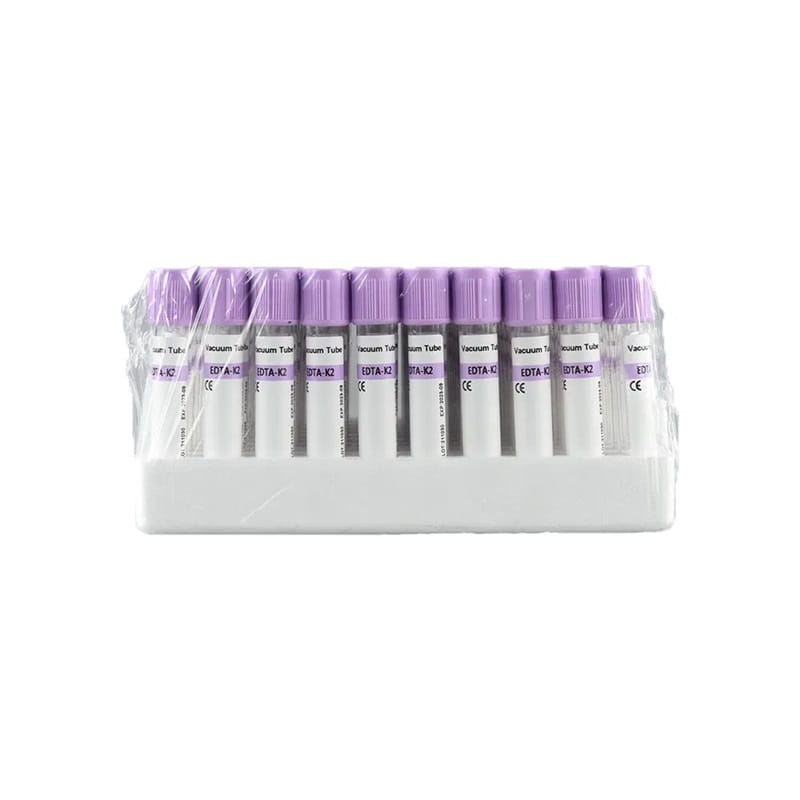
EDTA anticoagulant tubes are typically identified by a purple or lavender cap, a universal color code recognized across laboratories worldwide. You can learn more about this system in The purple cap EDTA anticoagulant tube system.
Common Tests Using EDTA Anticoagulant Tubes
EDTA tubes are routinely used for:
Complete blood count (CBC)
White blood cell differential
Platelet count
Hemoglobin and hematocrit analysis
Peripheral blood smear preparation
Because these tests rely on intact cells rather than clotting factors, EDTA is the ideal anticoagulant.
EDTA Tube Additives: K2 vs K3
Not all EDTA anticoagulant tubes are identical. The form of EDTA used inside the tube matters.
EDTA K2
EDTA K2 is typically spray-dried onto the inner wall of the tube. It causes minimal dilution of the blood sample and is widely recommended for hematology testing.
EDTA K3
EDTA K3 is usually provided as a liquid additive. While effective as an anticoagulant, it can slightly dilute the sample if the tube is underfilled.
Most laboratories prefer EDTA K2 for improved consistency. High-quality options are available in the EDTA tube product category.
How EDTA Anticoagulant Tubes Are Used in Practice
Using EDTA tubes correctly is just as important as choosing the right anticoagulant.
After venipuncture, the tube must fill to the intended volume to maintain the correct blood-to-anticoagulant ratio. Underfilling can cause cell shrinkage, while overfilling may lead to incomplete anticoagulation.
Immediately after collection, the tube should be gently inverted several times. This ensures uniform mixing of blood with EDTA, preventing microclots.
For functional details, see EDTA anticoagulant tube purple cap function.
EDTA vs Other Anticoagulants: A Practical Comparison
Understanding whether EDTA is an anticoagulant also means knowing when it should not be used.
EDTA vs Sodium Citrate
Sodium citrate also chelates calcium, but it is reversible. This makes citrate suitable for coagulation tests like PT and APTT, where clotting needs to be reactivated during analysis. EDTA, by contrast, binds calcium too strongly for such tests.
A deeper comparison is available in EDTA vs citrate tubes – best anticoagulant.
EDTA vs Heparin
Heparin works by enhancing antithrombin activity. It is preferred for some chemistry assays but can interfere with cell morphology. EDTA remains superior for hematology.
EDTA as an Anticoagulant in Molecular and Genetic Testing
Although EDTA is best known for hematology, it is also widely used for DNA-related applications. By preventing clotting and inhibiting nuclease activity, EDTA helps preserve nucleic acids in whole blood.
This makes EDTA tubes useful for molecular diagnostics, genetic screening, and research applications. Suppliers such as Siny Medical provide EDTA tube solutions tailored for both clinical and research use.
Why Quality Matters When Choosing EDTA Anticoagulant Tubes
Not all EDTA tubes perform equally. Poor manufacturing can lead to uneven additive distribution, weak vacuum pressure, or contamination—all of which compromise results.
Choosing a trusted supplier with documented quality control reduces pre-analytical errors. You can explore certified options in the EDTA tubes for blood collection section.
For buyers and distributors, reviewing supplier background and production standards—such as those listed on Made-in-China Siny Medical profile—adds another layer of confidence.
Product Availability and Professional Support
A complete range of EDTA anticoagulant solutions is available through EDTA Tube Products, including standardized purple-cap tubes suitable for global laboratory workflows.
For technical questions, customization needs, or bulk procurement inquiries, professional assistance is available via Contact Us.
Summary
So, is EDTA an anticoagulant? Absolutely. EDTA is one of the most reliable and widely used anticoagulants in clinical diagnostics. By chelating calcium ions, it prevents blood clotting, preserves cellular integrity, and ensures accurate hematology results.
From routine CBC testing to advanced molecular diagnostics, EDTA anticoagulant tubes play a vital role in modern healthcare. Choosing high-quality EDTA tubes from trusted suppliers supports reliable outcomes, reduces errors, and strengthens laboratory efficiency.
To explore professional-grade EDTA solutions and technical resources, visit edtatube.com.
FAQs
Is EDTA an anticoagulant or a preservative?
EDTA is primarily an anticoagulant, although its calcium-chelating ability also helps preserve cellular components during storage.
Why is EDTA the most common anticoagulant in hematology?
EDTA preserves cell morphology and prevents clotting without interfering with cell counts, making it ideal for hematology.
Can EDTA anticoagulant be used for coagulation tests?
No. EDTA binds calcium too strongly and interferes with clotting assays. Citrate is preferred for those tests.
Does EDTA affect biochemical test results?
Yes. EDTA can interfere with calcium, magnesium, and some enzyme assays, which is why it is not used for serum chemistry tests.
Are EDTA anticoagulant tubes safe for long-distance transport?
Yes, when manufactured properly. High-quality EDTA tubes maintain sample stability during transport.